How to Choose the Right Yard Drainage Solution
Quick Facts on Yard Drainage
- The three main causes of yard drainage failure are improper slope, soil with high clay content, or surface runoff that doesn’t have a place to go.
- Finding a solution that matches the problem is key to a lasting fix. If you don’t, you’ll likely see the problem return within a season.
- There are several types of drainage solutions, including French drains, swales, dry creek beds, catch basins, and regrading. Each one solves a different problem, so using the wrong one is a waste of time and money.
- If you live in New Jersey or many parts of the Northeast, you’re probably dealing with clay soil. This type of soil can complicate nearly every type of drainage system.
- We’ll go into more detail later in this article about which problems you can tackle yourself and when it’s best to call a licensed contractor.
If you fix the wrong drainage problem, you’ll probably see standing water again by the next heavy rain season.
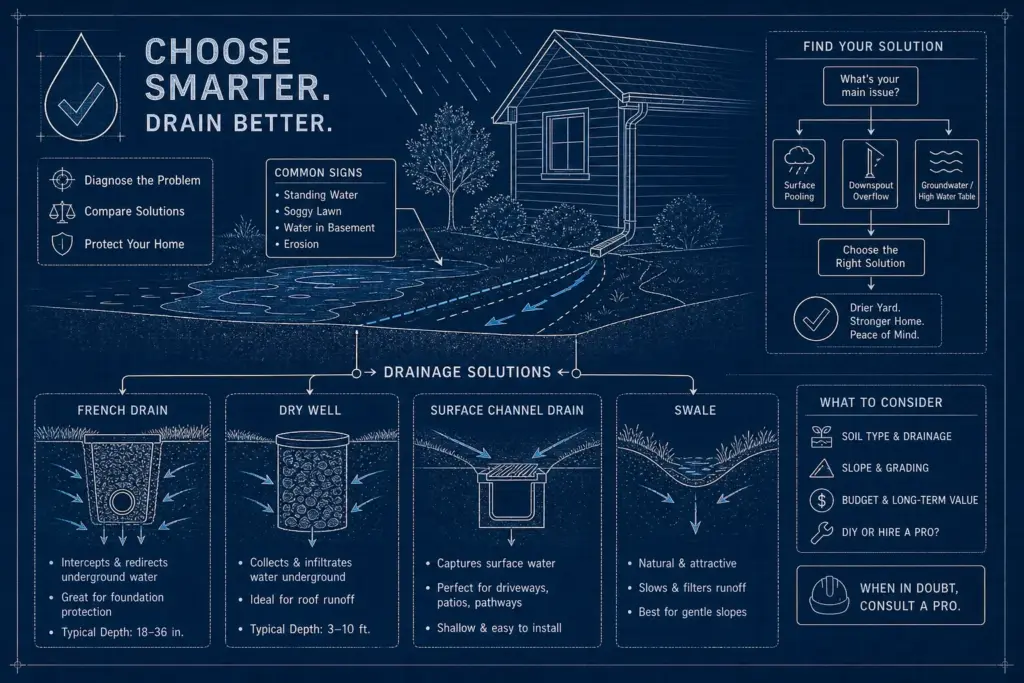
Yard drainage can seem like a complex issue, but it becomes much simpler once you know what’s causing the water to pool. Many homeowners lose money because they skip the diagnosis step. Whether you have a lawn that gets waterlogged after every storm, water that’s edging too close to your foundation, or a patio that turns into a shallow pool, there’s a solution out there. You just need to find the right one. At Sage Landscaping, we specialize in diagnosing and solving these types of drainage problems for homeowners all over Central New Jersey. The soil in this area is heavy with clay, which makes every drainage decision more important.
Three Main Causes of Yard Drainage Issues
Before you start looking into the cost of a French drain or renting a trencher, it’s beneficial to know that almost all home drainage issues fall into one of three categories. Once you understand which one you’re facing, the solution will be clear.
Incorrect Ground Angle or Tilt Towards the Home
Water always flows down, and the tilt of your yard — the angle of the ground — decides where it ends up. Typically, it’s suggested that the ground has a tilt of at least 6 inches downward for the first 10 feet away from your home. If the ground is flat or, even worse, tilts back towards the house, every time it rains, water is pushed against your basement or crawl space walls. This is one of the most typical reasons for foundation moisture issues and one that is often ignored.
Grade problems can be caused by soil settling, improper grading during the construction process, and erosion over time. The solution is regrading, which involves manually reshaping the soil. This process is simpler than most people think, but it requires a lot of physical labor.
Water Won’t Absorb in Clay-Heavy or Compacted Soil
Loamy and sandy soils drain well because water can move through the spaces between the particles. However, clay soil is more like a slow-draining bowl — it’s slow to absorb water and retains it for a long time. Soil can also become compacted due to foot traffic, heavy equipment, or years of mowing, which creates a similar issue. When water can’t move down through the soil, it stays on the surface until it either evaporates or runs off.
Water Accumulating with Nowhere to Go
Hard surfaces — such as driveways, patios, sidewalks, and compacted grass — repel water instead of soaking it up. Without a designated path for the water to follow, it will naturally accumulate in the lowest part of your yard. This is exacerbated by downspouts that drain directly against your home’s foundation. This is a surface issue that requires surface solutions: swales, trench drains, rain gardens, or repositioned downspout extensions.
Understanding Your Yard Before Making a Purchase
The most common error homeowners make is purchasing materials before they’ve identified the issue. A French drain kit worth $400 won’t solve a slope problem. Regrading won’t help a yard where clay soil is the main problem. Take 20 minutes to understand your yard first.
Conducting a 24-Hour Test After a Downpour
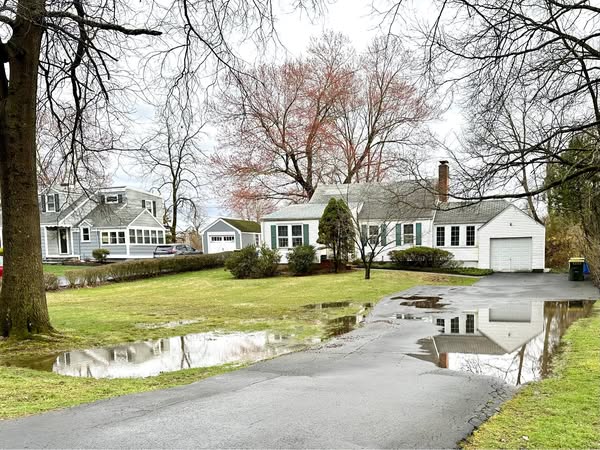
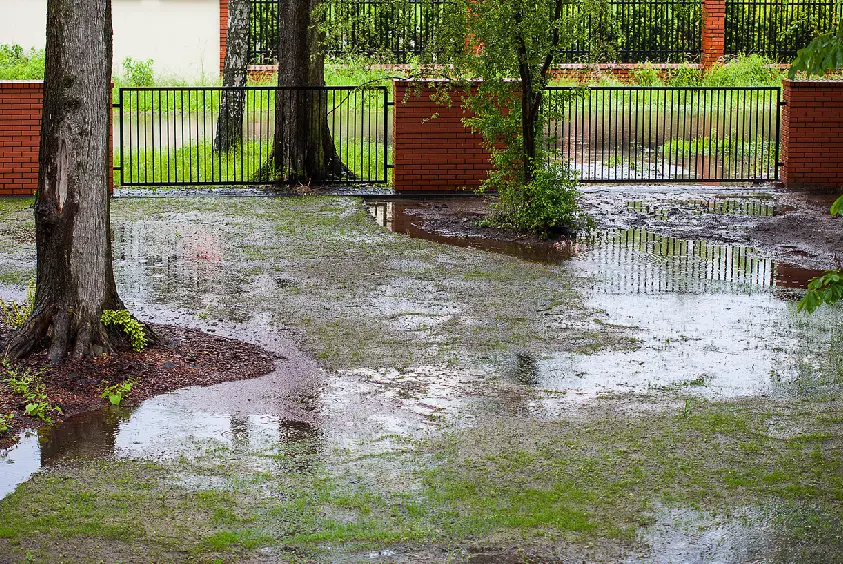
After a heavy rainfall — at least an inch — take a walk around your yard 24 hours later and take note of where water is still pooling. Take pictures. Identify the low points. If there is still water in your yard after 24 hours, it means the water has no place to go, either because of poor grading, oversaturated soil, or a blocked outlet. If the water disappears within a few hours, it’s a surface flow issue, not a subsurface one. This distinction is important because it indicates different solutions.
How to Use a Basic Level to Determine Your Yard’s Grade
You don’t need fancy surveying tools to get a reasonable assessment of your yard’s slope. Hammer two stakes into the ground — one close to the foundation and one 10 feet away — and tie a string between them. Use a line level to make the string level, then measure the distance from the string to the ground at the stake that’s farther out. You want to see at least a 6-inch drop over that 10-foot distance.
Quick Grade Check: If there’s less than a 6-inch drop in the first 10 feet from your home’s foundation, water isn’t moving away from your house quickly enough. Any slope running back toward the house should be regraded immediately, no matter what other drainage work you’re planning.
For larger yards or areas away from the foundation, you can use this method with longer string runs. The most important thing is a consistent fall — water needs a continuous downhill path all the way to an outlet, not just a slope that levels off halfway across the yard.
How to Tell if Your Soil, Not Your Yard’s Slope, Is the Issue
There are times when your yard’s slope is not the issue, but rather the soil is unable to absorb water quickly. Here’s how to identify this:
These are some symptoms to watch for:
- Even when the lawn is sloped correctly, water pools during moderate rain
- The ground feels spongy or waterlogged days after the rain has stopped
- Grass in affected areas is thin, yellowing, or replaced by moss
- Even when you dig 6 inches down, you find dense, sticky, gray or blue-gray clay
- Water moves across the surface in sheets rather than soaking in
If your yard has several of these symptoms, soil permeability is either the main problem or a contributing factor. That changes which solutions should be at the top of your list.

When to Use Surface Yard Drainage Solutions
Surface drainage solutions are designed to capture and reroute water before it can accumulate or seep into the ground. They are typically easier to install than subsurface systems and are often the perfect choice for many drainage problems.
Regrading: The First Solution Most Yards Need
Regrading is just what it sounds like — moving dirt to reshape the surface so water drains away from buildings and towards a controlled outlet. It’s the most basic drainage solution available, and it’s often the one that should be done before any other system is put in place. Putting a French drain in a yard with negative grade is like putting a bucket under a leak without fixing the pipe — it might manage symptoms but doesn’t address the problem.
If you’re dealing with a small area near the foundation, you can easily regrade it over the weekend using a wheelbarrow, topsoil, and a lawn rake. However, if you’re dealing with larger areas — anything that involves significant changes in slope or areas over a few hundred square feet — you might want to consider getting professional help. They have the necessary equipment and expertise to ensure a consistent fall across the entire surface.
Swales: Gentle Trenches That Direct Water Across Your Lawn
A swale is a shallow, gently sloped trench — typically lined with grass — that directs surface runoff across your lawn to a safe outlet such as a street, storm drain, or rain garden. They function by providing water a specific path to follow instead of allowing it to spread across the lawn and gather in low spots. Swales are cheap to create, fit into most landscapes naturally, and manage a large amount of water when properly sized.
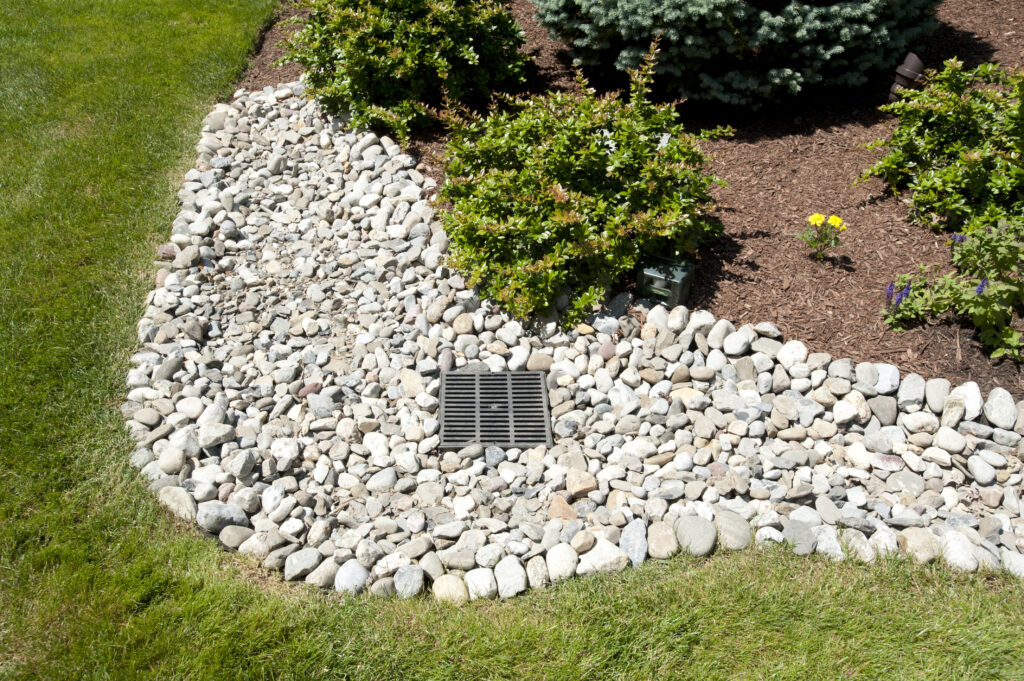
Dry Creek Beds: The Perfect Blend of Practicality and Aesthetics
Think of a dry creek bed as a swale, but instead of grass, it’s lined with river rock or decorative stone. It functions the same way a swale does, moving surface water, but it does so in a way that looks like a purposeful part of your landscape, rather than an afterthought for drainage. When it’s not being used for water flow, it doubles as a natural stone pathway or a feature in your garden.
These systems are particularly effective in places where grass swales might erode or have difficulty taking root, such as on steep inclines, in shaded yards, or in areas where foot traffic might harm a grass-lined channel. It’s important to make sure the channel is the right size: it needs to be wide and deep enough to accommodate your maximum runoff volume. For most residential uses, this typically means a channel that’s at least 12 inches wide and 6 inches deep, although larger drainage areas may require a deeper channel.
Channel Drains for Solid Surfaces Like Driveways and Patios
Channel drains — also known as trench drains or linear drains — are slim, grated inlets that are level with a solid surface to collect sheet flow across driveways, patios, pool decks, and garage aprons. Unlike French drains, which deal with water under the surface, channel drains are specifically designed for surface water moving across non-absorbent areas.
A well-placed trench drain should be located at the lowest point of the paved area and connected to a discharge pipe that directs water to a safe location. Polymer concrete channel systems with ductile iron grates, such as those in the NDS Pro Series, are the go-to for residential installations. This is because they can withstand the weight of vehicles without breaking and are less likely to clog than basic plastic alternatives.
Where to Place a Trench Drain: The drain must be located at the actual lowest point of the area, not just where it’s easiest to cut. Even a small mistake in placement means water misses the inlet entirely and keeps flowing to the next lowest point in your yard. Always double-check the slope of the surface with a level before cutting concrete or setting pavers.
If your driveway slopes toward your garage, a single trench drain positioned just in front of the garage door threshold often does the trick to catch all the driveway’s runoff before it gets into the garage.
What to Do About Deeper Yard Drainage Issues
If water is saturating the soil below the surface, not just pooling on top, surface solutions won’t be effective. Subsurface drainage systems are designed to intercept groundwater and soil moisture below grade and move it away from structures, root zones, and low-lying areas before it causes damage.
How Does a French Drain Work and Where Should It Be Installed?
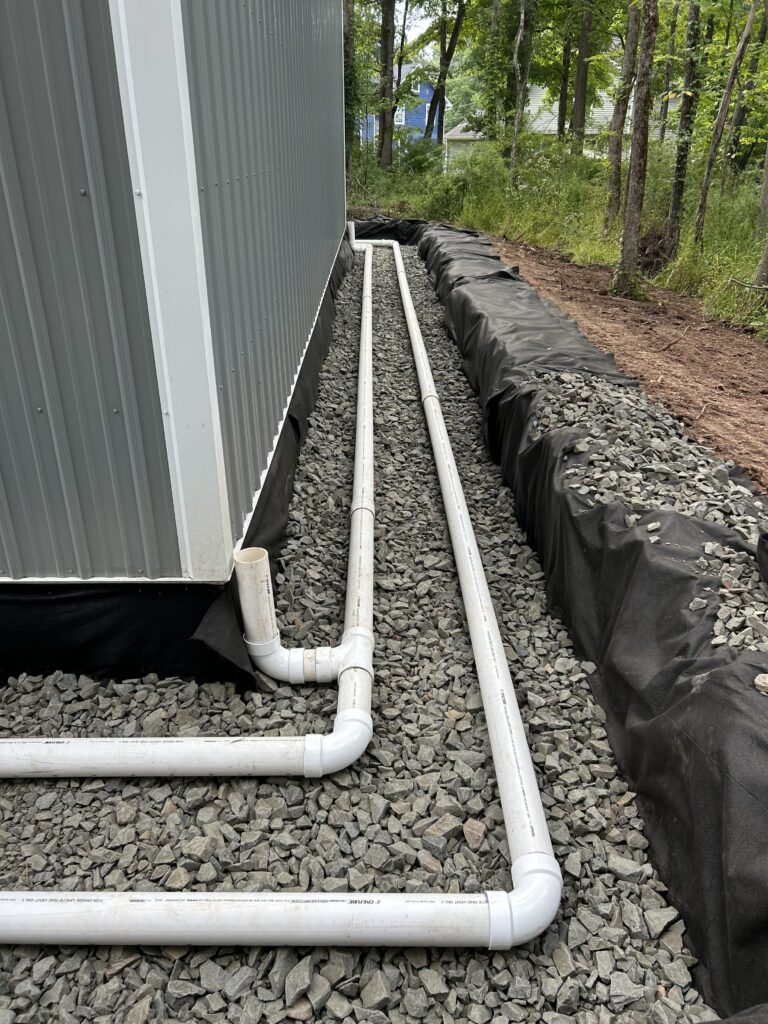
A French drain is a trench filled with gravel and a pipe with holes in it, all of which is wrapped in a filter fabric. Water gets into the gravel through the holes in the pipe, and then travels along the pipe, which is sloped slightly downhill — a minimum of 1% grade, or ideally, a drop of 1 inch for every 8 feet. The water then exits at a daylight outlet, a dry well, or a connection to a storm system. The filter fabric around the pipe and the gravel keeps soil particles from getting into the system and clogging it over time.
When you’re dealing with standing water in your yard that lingers for days after it rains, or areas that are at the bottom of a slope and collect water, you should consider a French drain. This is also a good solution for around the foundation of your home if water is building up and putting pressure on your basement or crawl space walls. You’ll want to install the drain 18 to 24 inches deep for yard applications, and even deeper if you’re using it around your foundation.
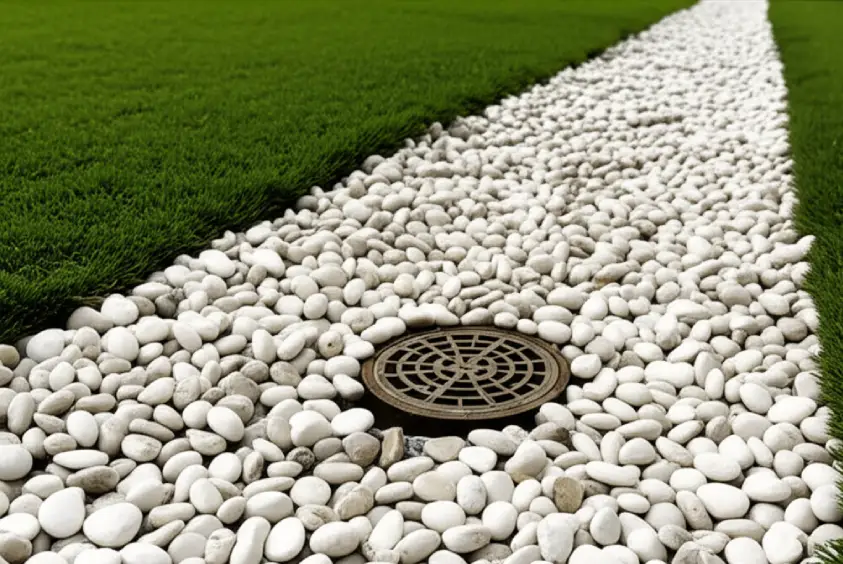
Catch Basins and French Drains: What’s the Difference?
People often confuse catch basins and French drains, but they have different functions. A catch basin is a type of surface inlet. It’s a box with a grate on top, and it captures standing water at a certain low point. The water then flows through a solid pipe to an outlet. This system deals with surface water at a specific collection point. A French drain, on the other hand, manages water below the surface across a linear area.
Many yards require both a catch basin and a French drain. The catch basin is often located at the lowest point of the yard to collect surface water that has pooled, while the French drain is positioned on the uphill side of the property to intercept groundwater before it can reach the surface. These two systems work well together and are often installed simultaneously as part of a complete drainage plan.
| Feature | Catch Basin | French Drain |
|---|---|---|
| Type of Water Handled | Surface pooling | Subsurface saturation |
| Type of Inlet | Grated surface box | Perforated pipe in gravel |
| Optimal Location | Fixed low point | Linear saturated zone |
| Type of Pipe | Solid outlet pipe | Perforated pipe with fabric |
| Maintenance | Clear grate and sump regularly | Flush periodically, inspect fabric |
The Functionality of Dry Wells and How Soil Type Affects Their Efficiency
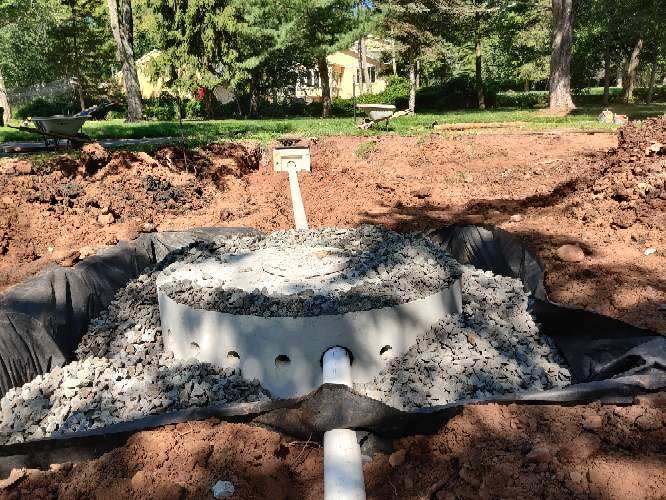
A dry well is a subterranean chamber, which can be a precast concrete ring, a plastic crate system, or simply a pit filled with gravel, that collects water and stores it while it slowly seeps into the surrounding soil. Dry wells are often used as outlets for downspout extensions, sump pump discharge lines, and French drains. When they are effective, they work very well. However, when they are installed in unsuitable soil, they fill up faster than they can drain and become ineffective within a season.
For a dry well to work, the soil around it must be permeable. In sandy or loamy soils, a properly sized dry well can handle hundreds of gallons per hour. But in soils heavy with clay, that same well might take days to drain. This means it can reach capacity during the first heavy rain and provide no relief for the rest of the storm. Before you install a dry well, do a simple percolation test: dig a hole 12 inches deep, fill it with water, and time how long it takes to drain. If it takes more than 24 hours to empty, a dry well isn’t the right solution for your site.
Long-Term Fixes with Rain Gardens and Permeable Surfaces
Rain gardens are designed to be shallow, planted depressions that capture runoff and allow it to slowly infiltrate over 24 to 48 hours. They are placed to receive water from downspouts, swales, or paved areas and are planted with deep-rooted native species that can handle both wet and dry conditions. In addition to their drainage function, they support pollinators, reduce erosion, and add real landscape value. Permeable pavers and gravel-based hardscaping operate on the same principle – letting water pass through the surface rather than sheet off it – and are increasingly common in driveways and patio installations where runoff reduction is a priority.
Clay Soil Throws a Wrench in Drainage Calculations
Almost all of the drainage system specs you’ll find online are based on average soil — typically loam to sandy-loam soil with decent permeability. But this assumption doesn’t hold water (pun intended) in regions with significant clay content, such as much of Central New Jersey, large parts of the Mid-Atlantic, and many areas throughout the Midwest and Southeast. Clay soil has a dramatically lower percolation rate than loam, meaning water moves through it much more slowly, and drainage systems that would work well in average soil underperform or fail outright.
The bottom line is that you may need bigger systems, different outlet strategies, or a combination of solutions. A dry well that works great in Connecticut loam may not work at all in Middlesex County clay. A French drain that would be enough for an average soil area may need to be twice as long or have a catch basin added to work the same in an area with a lot of clay.
Real Talk About Clay Soil Drainage: If your yard is mostly clay, you should plan on your drainage system being 25–40% larger than the size you’d find in a general guide. These guides are made for average conditions, and clay is anything but average — it needs a custom design, not a one-size-fits-all solution.
Why Drainage Systems for Average Soil Don’t Work in Clay
Here’s what usually happens: a drainage system made for average soil gets overwhelmed quickly in clay because the clay can’t absorb water fast enough to keep up with the water flowing into the system. French drains get backed up. Dry wells get waterlogged and stop working. Even trenches filled with gravel turn into temporary water storage instead of draining the water away. The filter fabric that’s supposed to keep soil out of the pipe can also get clogged faster in clay, which can stop water from getting into the system in just a few years if the fabric isn’t heavy enough.
How to Improve or Avoid Clay When Setting Up Any System
For tinier spaces, improving the soil is a plausible approach. Mixing rough sand and organic compost into the top foot of clay soil enhances its composition and permeability over time. This is most effective in planting beds and rain garden areas — not as a solution for broad drainage zones, where the amount of improvement required becomes unfeasible.
When it comes to drainage installations in clay-soil, it’s usually best to engineer around the clay rather than trying to fix it. This involves routing discharge to a reliable outlet. This could be a daylight point at a slope, a municipal storm connection where permitted, or a surface swale. It’s generally not a good idea to rely on soil percolation as the endpoint. If you’re installing French drains in a clay environment, make sure to use non-woven geotextile fabric rated for fine-particle filtration. You’ll also want to use a minimum 4-inch perforated pipe, and a confirmed gravity outlet rather than a dry well. These aren’t upgrades. If you’re dealing with clay soil, these are the baseline requirements for a system that will still be working in ten years.
What You Can Do Yourself vs. What Requires a Professional
Some drainage projects are truly doable for the average homeowner. However, other projects — especially those near a home’s foundation, requiring deep digging, or involving connection to city infrastructure — are risky enough that a mistake could cost much more to repair than the initial cost of professional installation. Knowing the difference can save you both money and stress.
Truth be told, the particulars of your property play a bigger role than the type of system you choose. A French drain in an open, easy-to-reach yard far from any buildings is a completely different project than the same system running next to a basement wall in dense clay. It’s the same solution, but the risk factors are very different.
Weekend Drainage Projects for the Handy Homeowner
If you’re a homeowner who’s handy with tools and not afraid of a little physical labor, there are several common drainage projects you could easily tackle in a weekend. Projects such as extending downspouts, redirecting downspouts to underground pipes, shaping basic swales in open lawn areas, installing dry creek beds, and small regrading projects using added topsoil are all doable. If you’re an experienced DIYer with access to a rented trencher, you could even install a 50-foot French drain in an open, accessible yard with average soil in just one to two full days.
Three key factors determine the success of these projects: ensuring the slope is correct (at least a 1% grade on any pipe run), using the right materials (non-woven filter fabric, clean washed gravel, slotted pipe — not corrugated black flex pipe), and making sure you know where your outlet is before you start digging. A DIY drainage project done well and with the right materials will last longer than a rushed professional job done with cheap parts.
When DIY is Too Risky Due to Proximity or Depth of Foundation
Most homeowners don’t realize the risk involved with any excavation within 3 to 5 feet of the foundation wall. Disturbing the soil next to a foundation can compromise its lateral support, and improper backfill after a trench is dug can actually funnel water toward the wall rather than away from it. Foundation perimeter drainage — interior or exterior — should be designed and installed by a contractor who understands hydrostatic pressure, waterproofing membranes, and proper backfill sequencing. The same applies to projects requiring connections to municipal storm drains, which in most jurisdictions require a licensed contractor and a permit regardless of project scope.
Always Dial 811 Before Digging
This is a must, no matter how shallow you think you’re going to dig. In the United States, dialing 811 will connect you to a free utility marking service. They will come out and mark the locations of any underground gas lines, water mains, electrical conduit, and telecommunications lines on your property. If you hit a gas line with a rented trencher, you won’t have a drainage problem, you’ll have an emergency. Always call at least three business days before you plan to start digging. And always respect the marked zones, even if they interfere with where you planned to dig your trench. It’s better to reroute the project than to reroute the pipe.
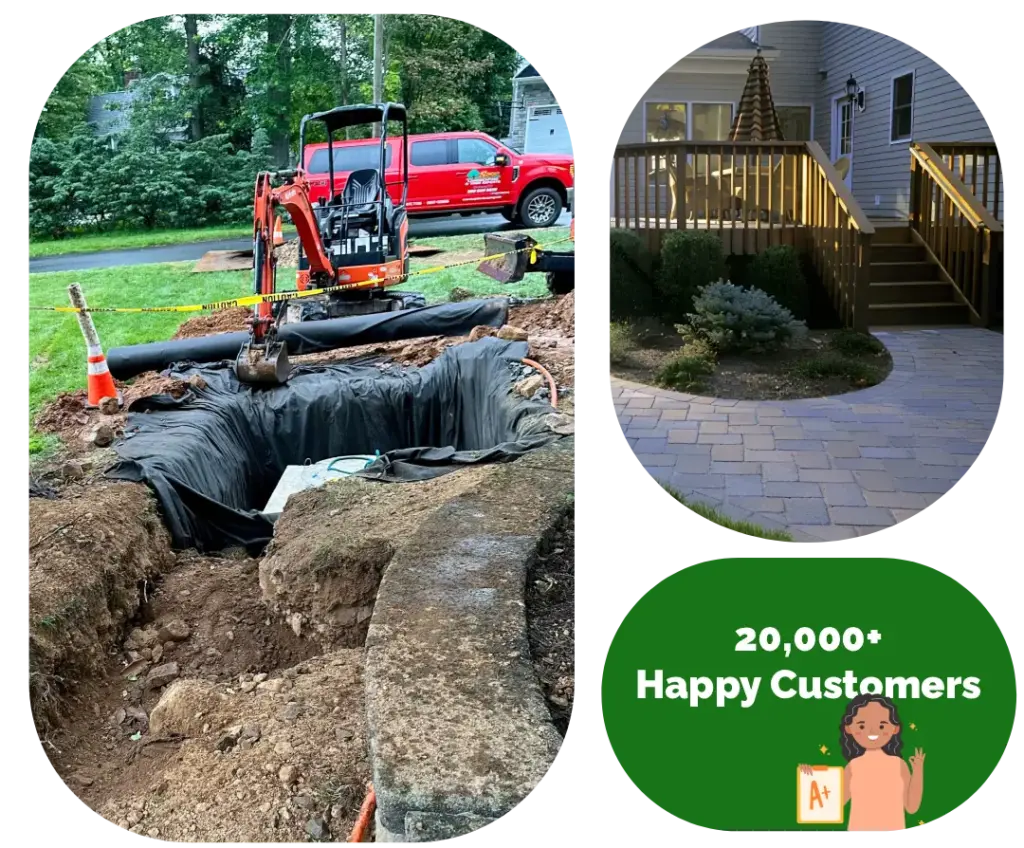
Let us here at Sage Landscaping Help Fix Your Drainage Problems
If you’re dealing with stubborn clay soil, foundation concerns, or have a yard that has proven difficult to drain, we at Sage Landscaping offer expert drainage evaluation and installation throughout Central New Jersey. We specialize in everything from French drain planning to large-scale regrading, always identifying the root of the problem before suggesting a solution.
Contact: (732) 356-0522
Area: Central New Jersey and surrounding areas
Website: sagelandscaping.com
Choosing the Right Drainage Solution Requires Accurate Diagnosis, Not Guesswork
All of the drainage systems discussed in this guide are effective — when used in the right circumstances. The reason so many drainage projects don’t succeed or don’t work as well as they should isn’t because of the system itself, but because the solution doesn’t match the problem. A catch basin won’t resolve issues with subsurface saturation. A French drain won’t fix a negative grade. Regrading won’t make a difference if clay soil is the main problem. The diagnostic step is not just important — it’s the basis for a solution that works.
Before you even think about spending money on supplies, you need to do some groundwork. Observe your yard, check the slope, test how well your soil drains, and figure out where your water is coming from. If you’re still not sure what the best solution is after doing all that, it’s worth it to pay for a professional to come check out your yard. It’ll cost you a lot less than having to redo an incorrectly installed drainage system.
Common Questions
Here are the questions most homeowners ask when trying to figure out their yard drainage — and we answer them straight up, no vague generalities like most guides.
What’s the Best Way to Drain a Flat Yard?
Flat yards can be more difficult to drain than sloped ones because there’s less gravity to help move the water. The best way to drain a flat yard is usually to use a combination of different systems, rather than just one.
| Flat Yard Problem | Best Primary Solution | Supporting System |
|---|---|---|
| Surface pooling at a low point | Catch basin with outlet pipe | Regrading toward basin |
| General soil saturation | French drain grid or loop | Outlet to daylight or sump |
| Runoff from impervious surfaces | Trench drain or swale | Rain garden as outlet |
| Clay soil, no slope | French drain to forced outlet | Soil amendment in planting areas |
In a flat yard, your outlet strategy matters more than in any other scenario. If water has nowhere to go once it enters your drainage system, the system backs up and stops working. Before installing anything, identify a reliable gravity outlet — a daylight point at your property edge, a connection to a storm drain (where permitted), or a sump pump as a mechanical backup when gravity outlets aren’t available.
If you have a yard that is almost entirely flat and there is no usable outlet grade, a sump pump system with a French drain feeding into a collection pit is often the most reliable long-term solution. The pump takes care of the elevation problem that gravity alone can’t handle.
Another great tip to keep in mind, especially for flat yards, is to aerate any compacted turf each year and reseed with grass varieties that have deep roots. While this won’t fix a major drainage issue by itself, it will help your soil absorb rainwater before it starts to pool. This means your drainage system won’t have to deal with as much water.
What’s the Ideal Depth for a French Drain?
When installing a French drain, the depth will vary depending on what you’re trying to drain. If you’re dealing with a soggy yard and pooling water, you’ll typically want the drain to be 18 to 24 inches deep. The pipe will rest at the bottom of the trench, which should be filled with at least 6 inches of clean, washed gravel (either ¾-inch or 1½-inch clean stone). The whole thing should then be wrapped in filter fabric.
When it comes to foundation perimeter drains, the depth needs to be increased to align with the bottom of the foundation footing, which is usually 4 to 6 feet or even more, depending on the structure. This is the point where doing it yourself becomes really risky. When you’re digging at those depths, right next to a foundation, you often need shoring, depending on the type of soil. If the wall fails during installation, the consequences can be very serious.
Regardless of how deep it is, the pipe slope is non-negotiable: it needs to have a minimum 1% grade (which is 1 inch of drop for every 8 linear feet of pipe) from the highest point to the outlet. If a French drain doesn’t have enough slope, it becomes a French pond — water goes into the pipe, doesn’t have anywhere to go, and then the system backs up. Always make sure you know what your outlet elevation is before you finalize your trench depth and layout.
Does Bad Yard Drainage Damage Foundations?
It sure does — and it’s one of the costliest home repairs you can face if you ignore drainage issues. When water collects against a foundation, it creates hydrostatic pressure, which is the outward and downward force that water-soaked soil exerts on a wall or footing. Over time, hydrostatic pressure can cause cracks in poured concrete and block foundation walls, let water into basements and crawl spaces, and in extreme cases lead to wall bowing or footing settlement.
Drainage problems are often overlooked because the damage they cause takes time to become noticeable. A foundation wall can withstand the hydrostatic pressure of seasonal changes for years before any visible damage appears. However, once the first crack forms, the damage can quickly escalate. Water seeping through these cracks can freeze and thaw in colder climates, causing the cracks to expand rapidly. This can compromise the structural integrity of the wall in just one winter. It’s always cheaper to address drainage problems before cracks form in the foundation, rather than after.
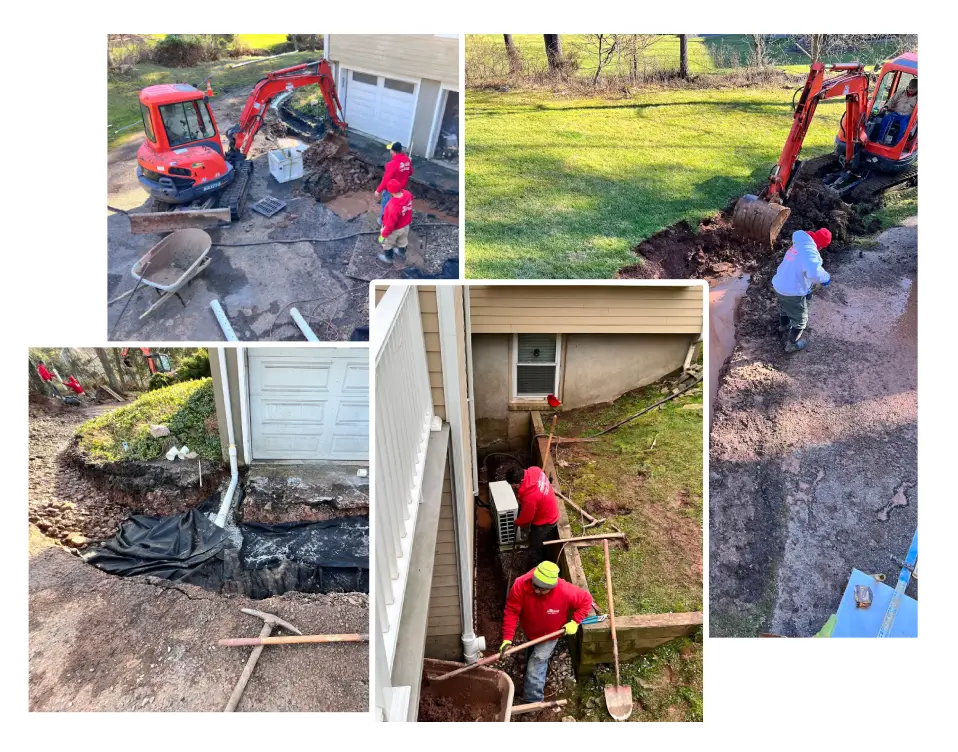
What is the Usual Lifespan of a Yard Drainage System?
There is a wide range of lifespans for yard drainage systems, depending on the type of system, the quality of the installation, and how well it is maintained. A French drain that has been correctly installed with non-woven geotextile fabric, clean stone, and a confirmed outlet can last anywhere from 30 to 40 years if it is flushed periodically. Catch basins that have solid PVC outlet pipes can also last this long, provided that the sump is regularly cleared of debris. Concrete trench drains with ductile iron grates are virtually permanent structures when they are installed correctly.
The primary reason for early failure in any underground drainage system is filter fabric blinding. This occurs when soil particles build up on the fabric surface, preventing water from entering the system. This process tends to occur more rapidly in clay soils than in sandy soils. Using a heavier, tighter-weave fabric designed for fine-particle filtration (look for fabrics rated at 50–70 AOS for clay environments) and cleaning the system with a garden hose every few years can significantly prolong the system’s lifespan. Systems installed with corrugated black plastic flex pipe — the inexpensive coiled type sold at big-box stores — tend to deform, crush, and clog within 5 to 10 years and are not recommended for permanent installations.
Is a Permit Needed for Yard Drainage Installations in New Jersey?
That will be determined by the extent of the work and your local government. In New Jersey, drainage projects that tie into the municipal storm sewer system almost always need a permit from your local government and sometimes approval from the county engineering office. Projects that change stormwater flow patterns in a way that could impact neighboring properties might also require a permit under the New Jersey Stormwater Management rules.
Work that is done entirely on your own property, such as a French drain that opens on your own property, a swale that ends in a rain garden, or a catch basin connected to an underground outlet within your property boundaries, often does not require a permit. However, this can vary from one township to another. Some municipalities have specific grading ordinances that require a permit whenever soil is moved beyond a certain volume.
Before you start digging for anything more than a flower bed, it’s a good idea to check with your local building or engineering department. A quick phone call can let you know if you need a permit, saving you the trouble of having to dig up and redo your work later. Licensed contractors in New Jersey deal with these permits all the time, so if you’re planning a big or complicated project, it might be worth it to hire a pro.