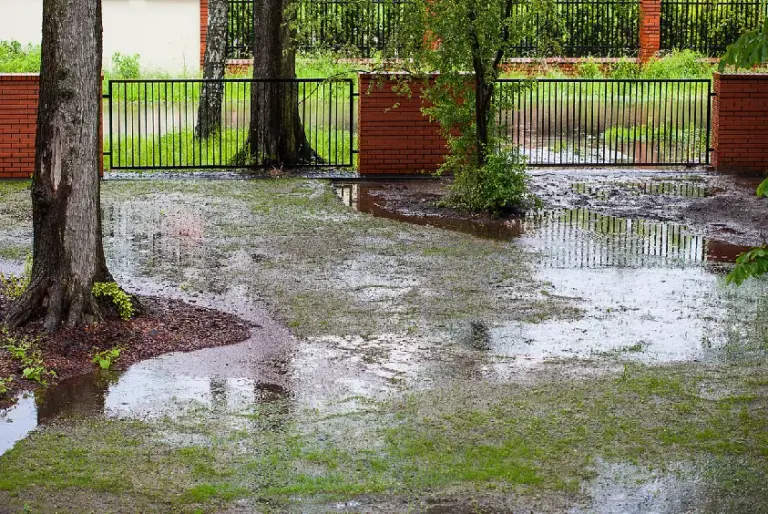
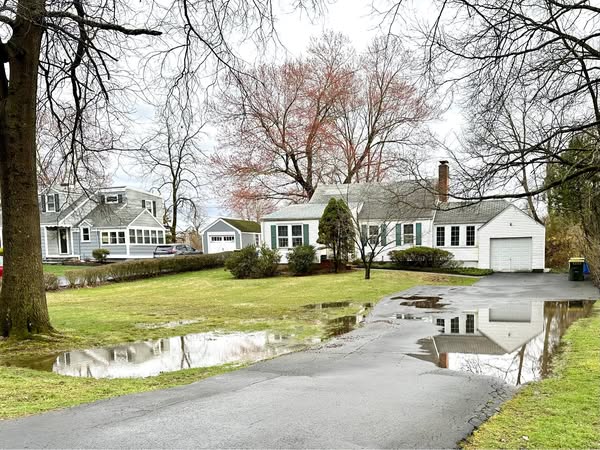
Best Yard Drainage Solutions, Tips & Soggy Lawn Fixes
Key Points:
- Pooling water in your yard is more than just a nuisance — it can cause damage to your foundation, kill your grass, and become a breeding ground for mosquitoes if not addressed.
- The optimal yard drainage solution is dependent on your unique issue — French drains, catch basins, channel drains, and regrading each address different problems.
- Sage Landscape Contractors are experts in professional drainage systems that safeguard your property and rejuvenate your outdoor living area.
- Some fixes for a waterlogged lawn are surprisingly inexpensive — aeration, top dressing, and planting strategically can make a significant difference without the need for major excavation.
- Ignoring drainage issues will always cost more in the long term — continue reading to learn exactly when a DIY solution isn’t sufficient and you need a professional.
Your Yard Is Suffering From Water Damage — Here’s What You Need to Know
A yard that retains water after every rainfall isn’t just irritating — it’s a gradually advancing threat to your home, your grass, and your finances. The good news is that most drainage problems can be completely resolved once you understand the cause.
There are many types of yard drainage issues. Some yards get flooded near the base of the house. Others have large wet spots in the middle of the lawn that never seem to dry. Some unfortunate homeowners have to deal with water coming in from neighboring properties or the street. Each problem requires a different solution, and choosing the wrong one can waste both time and money.
At Sage Landscape Contractors, we’ve seen our fair share of drainage issues. We’ve worked with homeowners from all walks of life, each with unique challenges. One common trend we’ve noticed is that many homeowners wait too long to address their drainage issues. What was once a small annoyance has turned into an expensive repair. The first step in fixing any problem is understanding the root cause.
Why Bad Yard Drainage Continues to Deteriorate
Water will always find the easiest route, and if your yard is prone to holding water, it will gradually alter that route in an unfavorable way. Soil becomes more compacted, grass starts to thin, and patches of bare earth start to appear — all of which exacerbate future drainage problems. It’s a cycle that intensifies after each heavy rainfall.
When water lingers, it causes more harm — not just to your lawn, but also to the structural integrity of your home and the quality of your outdoor air. What appears to be a simple puddle issue can quietly transform into a problem with your foundation or a health risk.
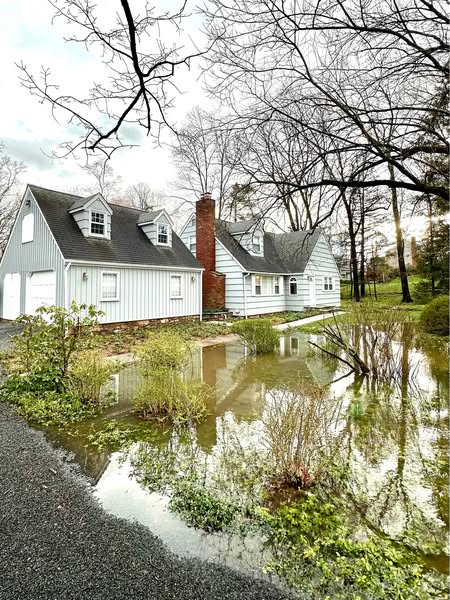
How Standing Water Can Harm Your Foundation
Having water accumulate near your home’s foundation is one of the most dangerous drainage issues you can encounter. The soil around the foundation can become soaked, causing it to expand and contract with changes in temperature. This results in lateral pressure against the walls of the foundation. Over time, this can cause the walls to crack or bow, and in extreme cases, it can lead to structural collapse.
Drainage experts usually follow the guideline that the earth should incline away from your home at a minimum grade of 6 inches for every 10 feet of horizontal distance. If your yard is level or inclines toward the home, water will naturally move toward the foundation each time it rains.
Why Does Soggy Soil Kill Grass and Plant Roots?
Grass and most ornamental plants require oxygen in the soil to live. When the soil is continuously waterlogged, air pockets become filled with water and roots essentially suffocate. Turf that is constantly wet becomes weak, thin, and is extremely susceptible to fungal diseases like brown patch and pythium blight.
Soils that are heavy in clay can be especially troublesome since they hold onto water for a longer period of time compared to sandy or loamy soils. Even if your yard doesn’t have a slope issue, if it has poor soil composition, it may drain slowly, making surface improvements like aeration and top dressing key parts of the solution.
Issues with Mosquitoes, Mold, and Other Moisture
Standing water is a perfect breeding ground for mosquitoes. Female mosquitoes only need approximately one inch of standing water to lay hundreds of eggs, and a yard that retains water for more than 72 hours following a rainstorm can generate substantial mosquito populations within a week.
- Any standing water that remains for more than 48-72 hours can become a breeding ground for mosquitoes
- Chronic dampness can lead to the development of mold and mildew on fencing, siding, and hardscaping
- Moist soil near the house increases the chances of moisture seeping into crawl spaces and basements
- Consistently wet mulch beds can become a breeding ground for fungus gnats and other lawn pests
- Algae can grow on hardscaping, creating surfaces that are slippery and dangerous
In addition to the problem of pests, consistent moisture around the outside of your house can create conditions that allow mold to grow on siding, fencing, and even interior walls. Crawl spaces and basements are particularly vulnerable when the soil around them stays wet, because moisture vapor can seep through concrete and wood over time.
Identifying Yard Drainage Problems
Yard drainage problems aren’t always easy to spot. Some issues, like water pooling after a rainstorm, are clear to see. Other issues are more difficult to identify and can only be detected by secondary damage, such as patches of dead grass, eroded mulch beds, or efflorescence staining on foundation walls.
It’s ideal to evaluate your yard’s drainage when it’s raining heavily or right after a downpour. Walk around your property and observe where the water is going, where it’s pooling, and how long it stays there. You’ll get a much more accurate idea of your yard’s drainage this way than you would on a dry day.
What to Look for After a Downpour
If you see puddles that stick around more than 24 hours after the rain has stopped, you likely have a drainage issue. There are other things to watch for, too. If the ground still feels squishy or sinks under your feet days after a storm, or if mulch consistently gets washed out of your flower beds, or if you see water stains on the lower part of your house’s foundation, these are all warning signs that your yard’s drainage is not up to par.
When water consistently flows over the same spot, it can create erosion channels. These are small grooves that are cut into the soil or lawn areas. This means that water is moving quickly and in a concentrated path. This type of runoff can quickly strip topsoil and deposit sediment in areas where you don’t want it, like patios, sidewalks, or storm drains.
Understanding Your Yard’s Natural Slope
Getting a basic understanding of your yard’s slope doesn’t require any special tools. Simply lay a long, straight board or level on the ground and use a regular carpenter’s level to determine the natural drainage direction of your yard. Do this in multiple areas to get a mental picture of the high and low points.
Drainage experts use a builder’s level or laser level for increased precision when calculating the exact grade percentages throughout the property. This information is crucial for deciding which drainage solution is best and where to install it for the most effective water interception and redirection.
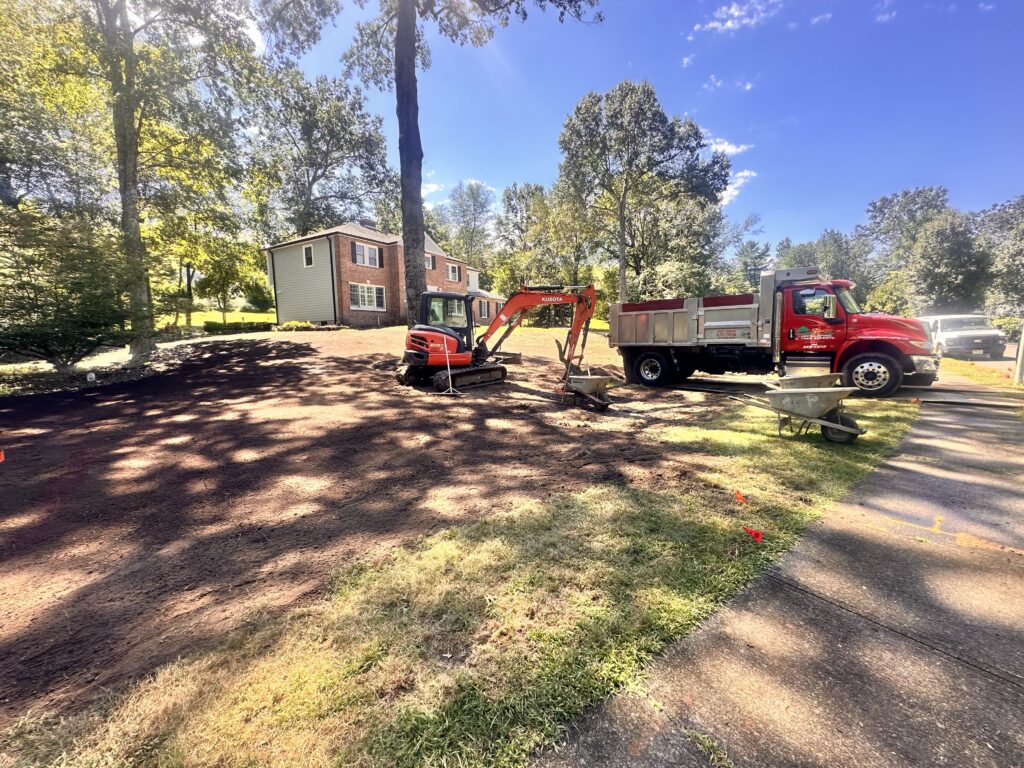
Top Yard Drainage Solutions
There isn’t a universal solution to this problem. The appropriate drainage solution depends on the source of the water, your property’s layout, soil composition, and the severity of the problem. However, a few tried-and-true systems effectively handle most residential drainage problems.
Some techniques are intended to stop water in its tracks as it moves across the surface. Other strategies aim to catch and reroute the subsurface water that sluggishly travels through the soil. The best drainage schemes usually use a combination of methods to tackle both surface and subsurface water movement at the same time.
Let’s take a look at the most popular and efficient yard drainage solutions that homeowners are using today.
- French Drains — These are underground pipe systems that are perforated to capture and redirect groundwater.
- Catch Basins — These are collection grates at surface level that are connected to underground pipes to carry water away.
- Channel Drains — These are linear trench drains that are perfect for driveways, patios, and hardscaped areas.
- Dry Creek Beds — These are decorative channels lined with rocks that manage surface runoff naturally.
- Yard Regrading — This involves reshaping the land itself to direct water away from problem areas.
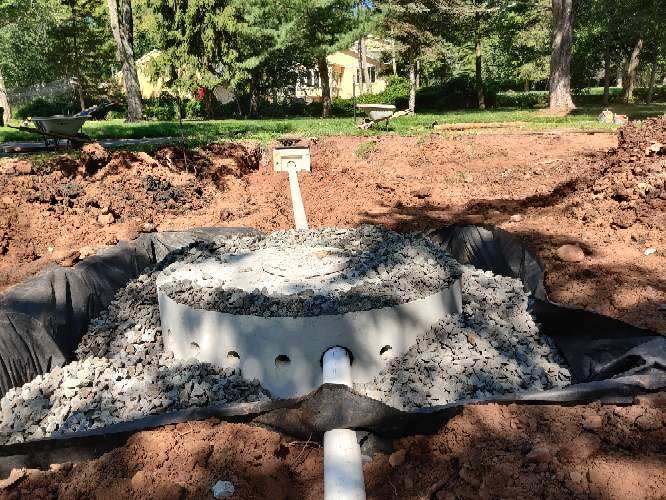
1. French Drains
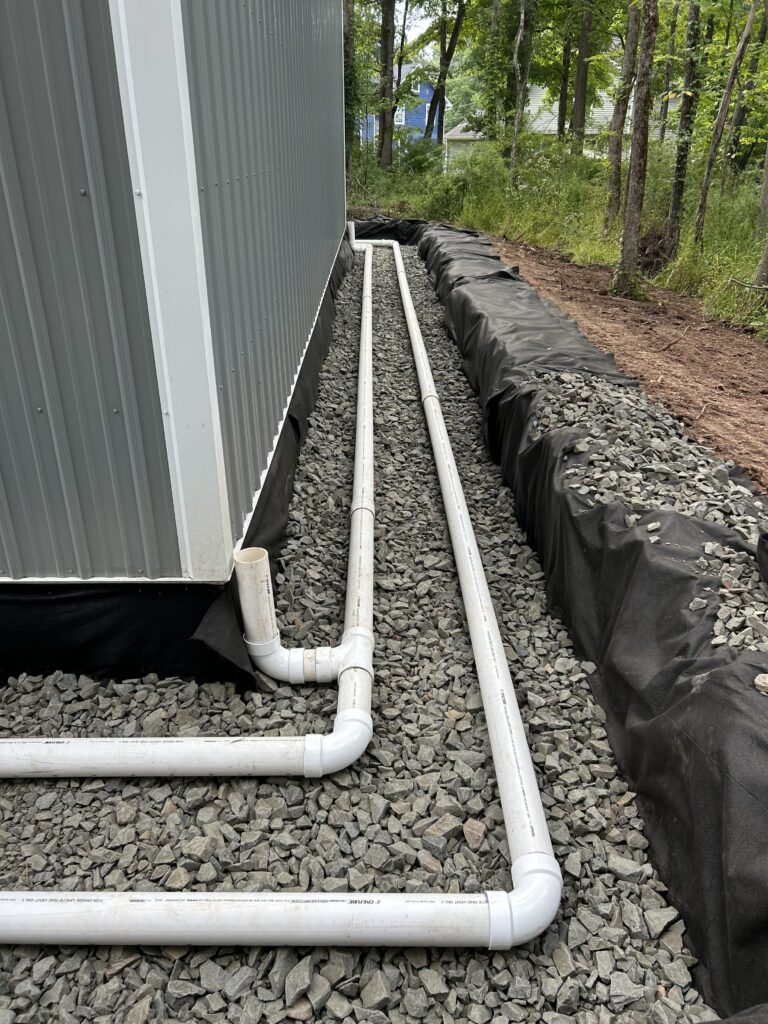
A French drain is a highly effective and commonly used underground drainage system. It is made up of a perforated pipe that is wrapped in a filter fabric and buried in a trench filled with gravel. This trench runs from the problem area to a suitable outlet, which is usually a storm drain, dry well, or a point at a lower elevation on the property that is exposed to daylight. Water enters the pipe through the perforations, travels through the pipe, and exits far away from your yard or foundation.
Usually, French drains are installed at depths of 8 inches to 2 feet. The depth depends on whether the drain is needed to address surface saturation or deeper groundwater intrusion. The trench is typically 6 inches wide and is lined with landscape fabric to prevent soil from clogging the gravel over time. If there is water intrusion at the foundation level, a deeper curtain drain variant is used. This intercepts groundwater before it reaches the structure. When properly installed with a minimum slope of 1% grade (1 inch of drop per 8 feet of run), a French drain system can last 30 to 40 years with minimal maintenance.
2. Catch Basins
Also known as a yard drain or area drain, a catch basin is a grate inlet that sits at surface level and is connected to a network of underground pipes. It’s designed to sit flush with the lawn or hardscape surface, collecting water that pools in a specific low spot. The water that it collects then travels through PVC or corrugated pipe to an outlet point away from the problem area. Catch basins are the go-to solution for yards with a single identifiable low point that consistently floods. You can also daisy-chain them together across larger areas using a network of connected pipes.
3. Channel Drains
Channel drains, sometimes referred to as trench or linear drains, are long, slender surface drains that are installed flush with hard surfaces such as driveways, patios, and pool decks. They are designed to intercept sheet flow, which is water that moves rapidly across a flat or slightly sloped hard surface, before it can reach doorways, garages, or lawn areas. A typical residential channel drain will use a 4-inch or 6-inch wide HDPE or polymer concrete body with a removable grate on top for cleaning. They are particularly effective in situations where a driveway slopes towards a garage door or where patio runoff regularly floods a lawn edge.
4. Dry Creek Beds
Not only does a dry creek bed solve drainage issues, but it also adds a touch of beauty to your landscape. This shallow, rock-lined channel is designed to divert water away from trouble spots and slowly release it into a lower area of your yard or a rain garden. The rocks slow the water down, reduce erosion, and allow some of the water to seep into the soil along the way. If done correctly, a dry creek bed can look like a natural stream and become one of the most beautiful features in your yard, solving a drainage problem while adding a real visual appeal.
5. Redesigning Your Yard’s Slope
When the main issue is that your yard just doesn’t have the right incline, redesigning the slope is the most straightforward solution. This method requires reshaping the terrain itself by adding or redistributing dirt to create a positive incline away from buildings and towards proper drainage outlets. Redesigning the slope is usually the basis of any complete drainage plan because no pipe system can fully make up for a yard that consistently channels water towards the wrong places. It’s a more work-intensive solution, but it gets to the heart of the problem rather than just dealing with the symptom.
Affordable Solutions for a Wet Yard
You don’t always need a complex pipe system or large-scale digging to fix a drainage problem. If your yard takes a while to drain but doesn’t get severely flooded, a few specific low-cost solutions can help a lot. These solutions are most effective for yards with soil that’s somewhat compacted, has low organic matter, or has minor grading problems, rather than serious structural drainage issues.
These strategies can be seen as your first line of defense. They’re practical measures you can implement before deciding to embark on a more significant drainage project. Sometimes, these steps are all you need. Other times, they’re an intelligent addition to a professionally installed drainage system, helping to keep your lawn in better shape and more resistant to damage between heavy rainfalls.
Aeration: The Fastest Solution for Compacted Soil
Core aeration is a method that removes small plugs of soil — usually 0.5 to 0.75 inches in diameter and 2 to 3 inches deep — from the entire lawn surface using a mechanical aerator. This method breaks up compaction, creates pathways for water to move downward, and significantly enhances the lawn’s ability to absorb rainfall. For heavily compacted lawns, a single aeration session can noticeably decrease surface ponding within one or two rain cycles. Aerating once in the fall and once in the spring gives lawns that are prone to compaction the best opportunity to remain open and drain effectively throughout the year.
Applying a Top Dressing of Sand and Compost
Top dressing is a process that involves spreading a thin layer of a sand and compost blend, usually ¼ to ½ inch thick, across the surface of the lawn after it has been aerated. This material will then make its way down into the holes made by the aeration, and over time and with multiple applications, it will help to improve the texture and drainage capacity of the soil. A blend of 70% coarse sand and 30% compost is often used for this purpose, as the sand helps to increase the space between the soil particles, and the compost adds organic matter that can help to improve the structure of the soil and increase microbial activity.
Remember, top dressing alone can’t solve severe drainage issues, but if you apply it consistently over two to three growing seasons, it can significantly improve a lawn that drains slowly due to clay-heavy or compacted soil. Don’t use fine sand, because it can worsen compaction when mixed with clay. Always use coarse, angular sand specifically rated for turf applications.
Using Water-Loving Plants as Ground Cover
Planting is a drainage solution that is often overlooked. Some plants, such as blue flag iris (Iris versicolor), cardinal flower (Lobelia cardinalis), rain lilies (Zephyranthes spp.), and sweet flag (Acorus calamus), thrive in consistently moist soil and can help remove water from saturated areas by transpiration and deep root systems. If these species are planted in the low-lying areas of the yard that tend to stay wet, they can reduce the duration of standing water and improve the overall drainage of the soil, while adding seasonal color and wildlife value to the landscape.
Knowing When to Call in the Pros
There are plenty of drainage issues that you can tackle on your own. Whether it’s aerating your lawn, installing a small surface drain, or planting moisture-loving plants, the average homeowner can typically handle these tasks. However, there are certain jobs that are best left to the professionals. They have the right tools, the expertise, and the knowledge of local grading codes and utility locations.
When you notice any of the following, it’s a sign that you need to hire a professional drainage contractor instead of trying to fix it yourself:
Situation Why It Needs a Pro Water pooling within 3 feet of your foundation Risk of structural damage requires precise grading and pipe placement Basement or crawl space moisture after rain May require exterior waterproofing combined with drainage work Neighbor’s water draining onto your property Legal and engineering considerations require professional assessment Yard holds water more than 48 hours after rain Indicates systemic drainage failure beyond surface-level fixes Erosion channels cutting through lawn or beds Water velocity requires engineered redirection, not just surface patching Previous DIY fixes that haven’t worked Misdiagnosed root cause needs professional evaluation
Professional drainage contractors bring more than just labor — they bring diagnostic tools, grading expertise, and knowledge of how water moves across a specific property. A well-designed system installed correctly the first time will always outperform a series of trial-and-error fixes that address symptoms without solving the underlying cause.
Stop Drainage Issues Before They Happen
The cheapest way to handle drainage is to stop it before it becomes an issue. By being proactive with your yard — choosing the right plants, keeping your gutters clean, and making smart landscaping decisions — you can avoid the conditions that cause ongoing drainage issues. Paying attention to how water flows through your yard can save you a lot of money in the long run.
The Impact of Gutters and Downspouts on Your Yard
When a heavy storm hits, your roof has to deal with a lot of water, and if your gutters and downspouts aren’t doing their job, that water is going straight into your yard. In fact, a roof that’s 1,500 square feet can shed over 900 gallons of water in a single 1-inch rain event. If your downspouts are discharging within 2 to 3 feet of the foundation — which is how most homes are set up — then every time it rains, all that water is being concentrated in the worst possible spot.
One of the easiest and most frequently overlooked drainage improvements is the use of downspout extensions. A simple rigid or flexible extension that moves water at least 6 to 10 feet away from the foundation can greatly reduce soil saturation near your home. For a more lasting solution, a downspout can be linked to an underground pipe that connects to a French drain system or a daylight outlet at the edge of your property, completely eliminating roof runoff from the foundation zone.
Landscaping Choices That Help with Drainage
The choices you make when it comes to plants, hardscaping materials, and layout of your landscape can directly impact the way water flows through your property. If you replace large areas of impervious hardscape, such as concrete, solid pavers, or asphalt, with permeable alternatives like gravel, permeable pavers, or decomposed granite, rainfall will be able to infiltrate the ground instead of running off. A single permeable driveway can significantly reduce surface runoff volume during a moderate rain event. Rain gardens, which are shallow depressions planted with various plants that are designed to capture and absorb runoff from roofs, driveways, or lawns, are another highly effective landscaping tool. They can also serve as an attractive focal point in the yard.
Let us at Sage Landscape Contractors Help Fix Your Drainage Problems
Are you dealing with stubborn clay soil, foundation concerns, or have a yard that has proven difficult to drain? We at Sage Landscape Contractors offer expert drainage evaluation and solutions throughout Central New Jersey. We specialize in everything from French drain planning to large-scale regrading, always identifying the root of the problem before suggesting a solution.
Contact: (732) 356-0522
Area: Central New Jersey and surrounding areas
Website: sagelandscaping.com
Choosing the Right Drainage Solution for Your Yard
Every yard is unique, and there is no one-size-fits-all drainage solution. Even the best solution, if it’s not the right one for your yard, won’t fix your drainage problem. For example, a catch basin in a yard that needs to be regraded will just fill up with water and not drain anywhere. Similarly, a French drain in a yard without a proper outlet will just move the water saturation to a different location. The key to effective drainage is to accurately diagnose the source of the water, how it flows, and where it needs to go. This sequence – source, path, outlet – is the guiding principle behind every successful drainage design, whether it’s a simple DIY project or a professionally installed system.
Common Questions
Still unsure about how to handle your waterlogged yard? Here are some simple answers to the drainage questions we hear most often from homeowners.
What Is the Best Yard Drainage Solution?
The best yard drainage solution is the one that fits your specific problem. If you have subsurface water and need to protect your foundation, a French drain is always the best option. If you have surface flooding in low areas, catch basins work best. If you have hardscaped areas like driveways and patios, channel drains are the best solution. In many cases, regrading combined with a subsurface pipe system addresses both the root cause and the symptoms at the same time. This makes it the best overall solution for severe or complex drainage problems.
What is the Cost of Yard Drainage Repair?
The cost of drainage repair can differ greatly depending on the system type, the size of the area, and the local labor rates. Basic solutions such as downspout extensions or lawn aeration can be quite inexpensive. A French drain that is professionally installed usually costs between $25 and $60 per linear foot, depending on the depth, soil conditions, and outlet requirements. The cost of installing catch basins often ranges from $500 to $2,500 per basin including pipe runs. Full yard regrading projects can range from $1,000 to over $5,000 depending on the size of the property and the amount of material that needs to be moved. It is always cheaper to invest in the right solution upfront than to repair the damage caused by an inadequate one.
Is it possible to rectify a waterlogged lawn without regrading?
Yes, it often is. If the gradient of your yard is fine but soil compression or bad soil composition is causing slow drainage, aeration combined with top dressing can make a big difference over one or two seasons. Installing a catch basin or French drain can also solve localised flooding without altering the gradient. However, if your yard slopes towards your house or has persistent low spots that collect water with no natural outlet, regrading is ultimately the only permanent solution. A drainage contractor can assess whether a pipe-based solution can make up for gradient problems before recommending excavation.
What is the Ideal Depth for a French Drain?
The depth of a French drain largely depends on its purpose. If you’re dealing with surface water or a waterlogged lawn, then a depth of 8 to 18 inches will usually do the trick. However, if you’re trying to safeguard a foundation or divert deeper groundwater, the drain will need to be installed at or below the footing level of the building, which often means a depth of 2 feet or more. To prevent water from pooling in the pipe, it should always be installed with a minimum slope of 1% grade in the direction of the outlet.
Can Lawn Aeration Aid in Drainage?
Indeed, lawn aeration can assist in drainage, but its effectiveness is entirely dependent on the root cause of the issue. If slow drainage is primarily due to soil compaction – a very common occurrence in lawns and yards with heavy foot traffic and clay-rich soil – aeration can result in a noticeable improvement in the speed at which water passes through the surface layer. Core aeration creates channels that allow water to infiltrate rather than run off or accumulate on the surface.
However, aeration is not a replacement for a good drainage system. It won’t divert water that’s headed for your foundation, repair a yard that doesn’t have enough slope, or solve issues related to a high water table. Consider it a maintenance tool that keeps your soil open to drainage solutions, not a standalone solution for major water management problems.
Even with regular aeration and top dressing, if your yard still retains water, the problem is likely structural and not biological. This is the type of issue that Sage Landscape Contractors can identify and fix with professionally designed drainage systems that are built to last.