Best NJ Inground Pool Renovation & Replacement Tips, Ideas
Pool Renovation: The Basics
- Renovating an existing inground pool is usually cheaper than a complete replacement. However, there are times when replacing the pool is a smarter investment in the long run.
- New Jersey’s freeze-thaw winters can be harsh on pool surfaces, tile, coping, and plumbing. The right materials used during renovation can mean the difference between a fix that lasts and one that fails in two seasons.
- Upgrades like variable-speed pumps, quartz or pebble finishes, and LED lighting can dramatically lower operating costs and change the look and feel of the pool.
- A pool renovation is a great time to redesign the entire backyard, not just the pool, with hardscape, lighting, and plantings that work together as one cohesive space.
- Choosing a contractor with a lot of local NJ experience isn’t just about quality. It’s also about permits, soil conditions, drainage, and knowing which materials can withstand a New Jersey winter.
If your inground pool is looking worn out, is costing a lot in energy, or just doesn’t fit the backyard you want, you’re probably asking yourself one big question: should I renovate or replace?
Choosing between renovating and replacing your pool isn’t always a straightforward decision — and making the wrong choice can end up costing you a significant amount of money. The professionals at Sage Landscaping have over 40 years of experience helping homeowners in New Jersey make this important decision. The choice is about more than just the pool’s appearance.
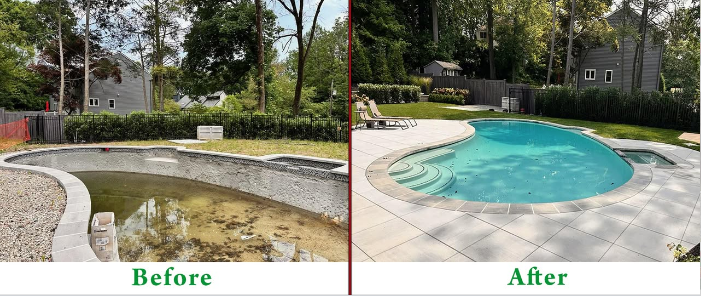
Why You Should Consider Renovating Your Old NJ Pool
Older inground pools not only look outdated, they can also be a drain on your resources. Old single-speed pumps can use up to three to four times more electricity than modern variable-speed models. Aging plaster can create rough surfaces that can tear swimsuits, create a breeding ground for algae, and make chemical balancing a constant struggle. Failing coping and cracked decking not only look bad, they can also cause structural damage to your pool in New Jersey as they allow water to seep in, freeze, expand, and cause damage each winter.
It can be costly to ignore the need for renovations. High energy bills, excessive chemical use, frequent patch repairs, and the gradual wear and tear of the pool shell can add up over time. In effect, many homeowners are paying for a renovation over several years without actually getting one.
How to Know When Your Inground Pool Needs Renovation (Not Just Repairs)
There is a clear distinction between a pool that requires a simple repair and one that is crying out for a major renovation. Individual problems — a broken tile here, a small chip in the plaster there — are just routine maintenance. However, when the problems begin to accumulate across various systems, that’s when you need to start thinking about renovation.
Keep an eye out for these unmistakable signs that your pool has moved from needing maintenance to requiring renovation:
- Water loss that can’t be attributed to evaporation or splash-out
- Staining, etching, or roughness on a large scale on the plaster or finish
- Coping stones that are cracked or shifting around the edge of the pool
- Delamination of the tile along the waterline or on the steps
- Algae blooms that are constant despite proper chemical maintenance
- Pumps, heaters, or filters that are over a decade old and frequently need to be repaired
- Cracking, settling, or lifting of the deck that results in trip hazards
- A pool design that no longer suits the way your family uses the space
If you’re agreeing with three or more of these, you’re not looking at a repair bill. Instead, you’re looking at a renovation plan.
How NJ Freeze-Thaw Cycles Can Cause Cracks, Leaks, and Surface Damage
Winters in New Jersey can be brutal on the infrastructure of a pool. When water manages to seep into even the tiniest crack in the shell, coping, or deck and then freezes, it expands with enough force to transform a minor issue into a major structural problem. After years of this freeze-thaw cycle repeating, the bond between the plaster and the gunite shell can be compromised, coping stones can be loosened from their mortar beds, and underground plumbing connections can be compromised. What may appear to be a simple surface problem at the waterline is often indicative of a deeper issue.
Is Outdated Equipment Increasing Your Energy Bills?
Single-speed pool pumps, which were standard in pools built before the mid-2000s, operate at full power all the time. A modern variable-speed pump, such as the Pentair IntelliFlo3 VSF, adjusts its speed to meet demand, using up to 90% less energy in low-flow situations. This isn’t a minor improvement — it’s the difference between a pool that costs $600 per season to operate and one that costs less than $100. When you consider the efficiency of heaters, automation systems, and upgrades to LED lighting, the equipment portion of a renovation often pays for itself in a few years.
Safe Swimming: Beware of Sharp Plaster, Loose Coping, and Broken Tile
When plaster starts to deteriorate, it doesn’t just look unattractive — it can also cut and scrape the feet of swimmers. If the coping stones around the edge of the pool are loose or raised, they can cause people to trip and fall. This danger is increased if the deck sections are cracked or lifting, especially when they’re wet. These aren’t just cosmetic problems that can be put off indefinitely; they’re safety hazards that homeowners need to take care of immediately.
Renovate or Replace: What’s the Best Option?
Many homeowners struggle with this question, often because they overestimate the power of a renovation or underestimate what a replacement entails. The best choice depends on the state of your pool shell, what you hope to achieve with the space, and your budget over the long haul.
Why Renovating Your Pool Is a Smart Investment
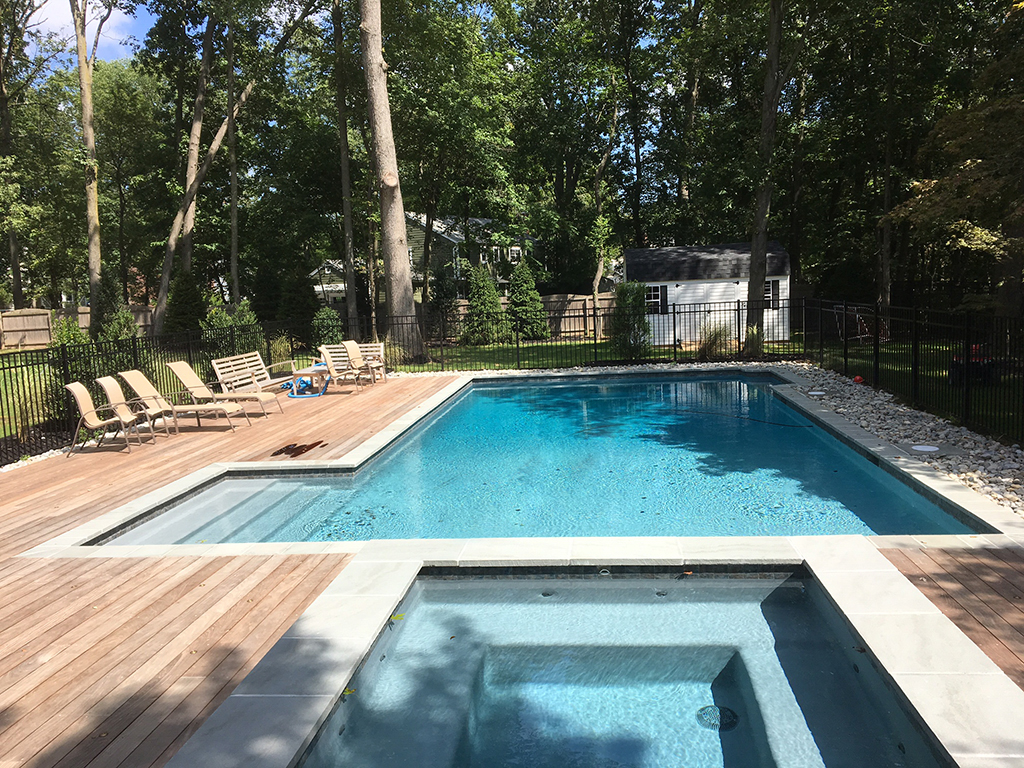
When your pool’s structural shell, which is the gunite or concrete foundation, is in good shape, renovation is almost always the better value. You can completely change the appearance and functionality of a pool by resurfacing, adding new tile and coping, updating equipment, and redesigning the deck for a fraction of the cost of new construction. Full pool replacement in New Jersey typically costs between $50,000 and $100,000 or more, depending on size, materials, and site conditions. A thorough renovation that includes surfaces, equipment, and decking can often be done for $15,000 to $40,000, and the results can look and feel brand new. For more detailed insights on pool construction and renovation, visit Sage Landscaping Services.
When It’s Time to Fully Replace Your Pool
There are times when it makes sense to replace your pool completely. This is typically when the structure of the pool is beyond repair. For instance, if you have significant gunite delamination, major damage from hydrostatic pressure, or a fiberglass shell that has warped or buckled beyond resurfacing, it’s time to consider a replacement. Additionally, if you want to significantly change the size, shape, or location of your pool, or if you’re planning a complete redesign of your backyard, it might be more logical to start fresh rather than trying to retrofit around the existing structure. It’s important to note that most pools don’t reach this point. However, if they do, trying to renovate a failing shell is like throwing money at a problem that won’t go away.
Top NJ Inground Pool Renovation Concepts You Should Try
Deciding to renovate your pool opens up a world of exciting possibilities. The progress in modern materials, equipment, and design options has been significant, and a carefully planned renovation can produce a result that surpasses what could have been built new 15 years ago.
Typically, the most effective renovations are those that address surfaces, features, and equipment all at once, rather than individually. Resurfacing a pool but leaving the old pump and cracked coping untouched is only a partial solution. Homeowners who see the best results view the renovation as a comprehensive upgrade across all systems.
Resurfacing Options: Plaster, Pebble, and Quartz Finishes
Finish Type Typical Lifespan Appearance Best For Relative Cost White Plaster 7–10 years Classic bright white Renovations on a budget $ Colored Quartz (e.g., SGM Jewels of the Sea) 12–15 years Subtle shimmer, many tones Mid-range upgrades with durability $$ Pebble Aggregate (e.g., Pebble Tec, Pebble Fina) 20–25+ years Natural, textured, rich color Premium look and longevity $$$ Glass Bead Finish 15–20 years Luminous, jewel-like High-end visual impact $$$
White plaster is the most basic option — it gives that classic bright pool look and is the most economical resurfacing choice. But in New Jersey’s climate, it’s also the most vulnerable. Plaster is calcium-based and highly susceptible to etching from pH swings and physical damage from freeze-thaw exposure. Most white plaster finishes in NJ need resurfacing every seven to ten years under ideal conditions.
Quartz aggregate finishes such as SGM’s Jewels of the Sea line are an excellent upgrade. The quartz particles are tougher and more resistant to chemicals than regular plaster, which means they last longer and perform better through NJ winters. They are available in a variety of colors and give the water a subtle sparkle that white plaster can’t match.
High-end finishes like Pebble Tec and Pebble Fina are the crème de la crème of the pool world. The natural pebble surface is not only beautiful and textured, but it’s also very durable, highly resistant to stains, and can last for two decades or more with the right maintenance. Pools with a dark pebble finish have a visually stunning water color and clarity, and they can withstand freeze-thaw cycles much better than pools with plaster-based finishes.
Upgrading Your Tile, Coping, and Decking Can Change Everything
Resurfacing may change the inside of your pool, but upgrading the tile, coping, and decking can change the entire look of your pool. These elements are exposed to a lot of wear and tear, including exposure to chemicals, UV rays, and thermal cycling. That’s why porcelain and glass tile have become the most popular choices for NJ pool renovations. Porcelain tile is dense and frost-resistant, and it doesn’t fade. This makes it a great choice for pools in areas where the weather freezes and thaws.
Upgrading to Water Features, LED Lighting, and Spa Additions
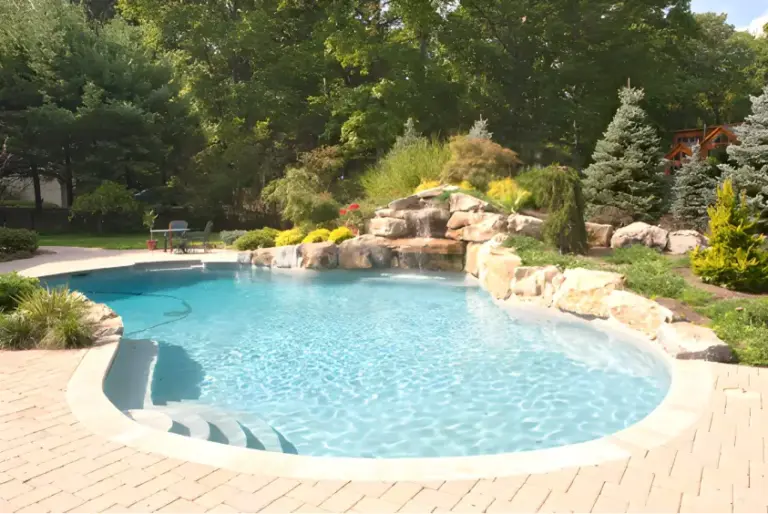
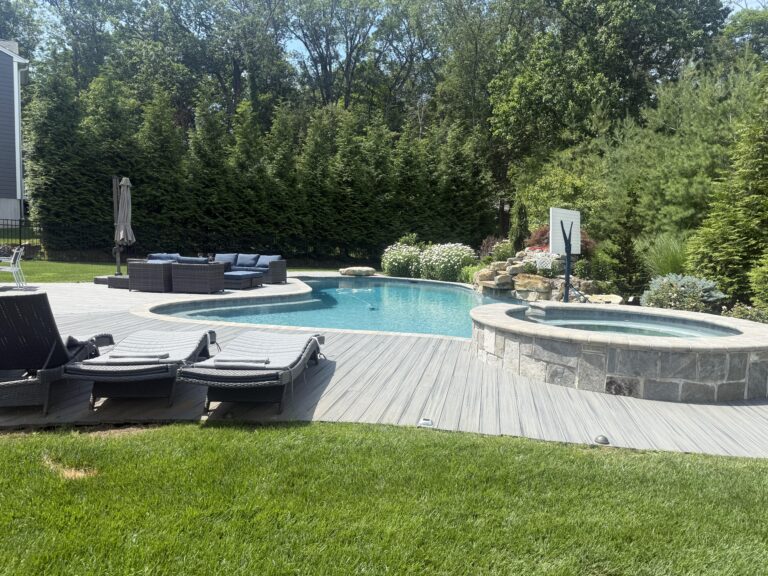
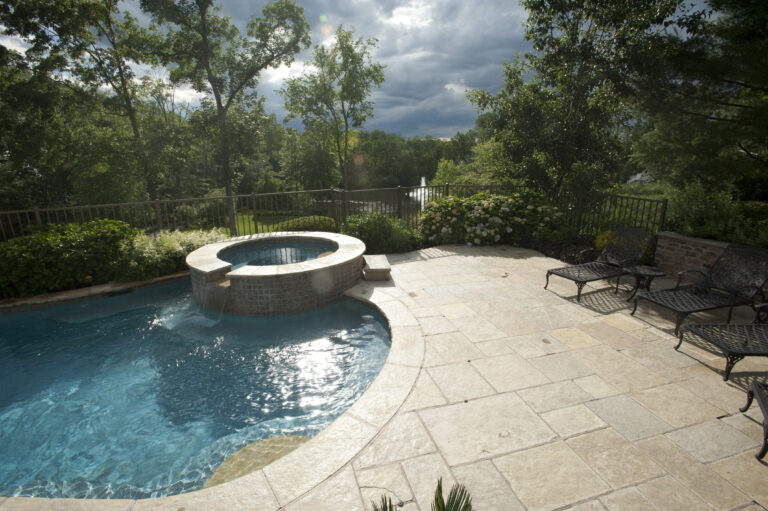
There’s nothing like adding water features and lighting to a pool renovation to take it to the next level. With the options available today, you can easily create a resort-like atmosphere. Deck jets that shoot streams of water into the pool, scuppers mounted into a raised wall, and sheer descent waterfalls can all be added to existing pools with the right planning. A raised spa with a spillover into the main pool is one of the most popular additions NJ homeowners request during renovations, and it’s easy to see why. It adds functionality, visual depth, and year-round usability to a space that might otherwise sit unused once the weather cools.
Another change that consistently surprises homeowners with its dramatic results is LED lighting. A single color-changing LED pool light, such as the Pentair IntelliBrite 5G, can cycle through millions of color combinations and sync with landscape lighting for a fully unified nighttime experience. The difference is striking compared to the dim, yellowish glow of an old 500-watt halogen fixture, and the energy savings are significant. LED pool lights use roughly 75% less electricity than halogen equivalents and last five to ten times longer.
Altering Pool Shape, Depth, and Entry Points
Many homeowners are unaware that a renovation can do more than just improve the pool’s aesthetics – it can also modify the pool’s functional design. One of the most popular changes at the moment is the addition of a tanning ledge. This is a shallow, flat shelf that is submerged just a few inches below the waterline, and it can be incorporated into the shallow end of most existing pools during a renovation. Beach entries, which gently slope into the water without steps, can sometimes be added, depending on the existing shell geometry of the pool. Changes that alter how the pool is used on a daily basis include deeper conversation areas, bench seating built into the walls, and relocated or upgraded step entries.
Adding Energy-Efficient Upgrades During Renovation
When renovating your pool, it’s the best time to upgrade your pool’s mechanical systems. This is because the equipment room is already being accessed and you can pair surface work with equipment upgrades to avoid duplicating labor costs. One of the most common and expensive mistakes NJ pool owners make is skipping this step during a renovation and then replacing equipment a few years later.
Modern Filtration Systems and Variable-Speed Pumps
Two of the most popular variable-speed pumps in the NJ market currently are the Hayward TriStar VS and Pentair IntelliFlo3 VSF. Both of these pumps qualify for utility rebates in many New Jersey service territories, which can help to offset some of the initial cost. These variable-speed pumps operate by running at lower RPMs during filtration cycles and only increase when a higher flow is required for features such as spa jets or waterfalls. This results in significantly lower electricity usage without any reduction in water quality or circulation performance.
When it comes to filtration, switching from an older sand filter to a cartridge filter system such as the Pentair Clean & Clear Plus or a DE (diatomaceous earth) filter can greatly enhance water clarity and decrease the need for backwashing. Cartridge filters can trap particles as tiny as 10 microns, in contrast to the 20 to 40 microns that standard sand can handle. This results in water that is cleaner, clearer, and requires fewer chemicals.
LED Pool Lighting vs. Traditional Halogen
Not only are traditional halogen pool lights dim and inefficient, but they also require frequent maintenance. The halogen bulbs burn out often, and because pool lights are underwater fixtures that are sealed, you typically have to drain the pool to the light niche or hire a diver to service them. Modern LED fixtures, such as the Hayward ColorLogic 4.0 or Pentair IntelliBrite 5G, are rated to operate for 30,000 to 50,000 hours. This means that most homeowners will never have to replace a bulb again after they switch.
The difference in color and ambiance is just as important. A programmable LED system allows you to create the perfect atmosphere for an evening dinner party, a child’s pool party, or a peaceful late-night swim, all from a smartphone app. If you’re already renovating, the additional cost of upgrading from halogen to LED is small compared to doing it as a separate project later.
Heating Your Pool in NJ: Gas Heaters vs. Solar
In New Jersey, gas heaters are the go-to for pool heating because they can quickly heat the water no matter what the weather is like. This is a real plus in a climate where you might want to take a dip on a chilly evening in May or keep swimming into October. Modern gas heaters like the Jandy Pro Series LXi or Hayward H-Series are much more efficient than older models. They have ASME-certified heat exchangers and digital controls, delivering efficiency ratings over 95% — a big step up from older models that ran at 80% efficiency or less. For more information about pool construction, you can visit Sage Landscaping Services in New Jersey.
For NJ pools that are mainly used during the hotter months, heat pumps are a good option. Units such as the Hayward HeatPro or Pentair UltraTemp take heat from the surrounding air and transfer it to the pool water. This method is far more energy-efficient than creating heat from combustion. The downside is that heat pumps become less efficient when the air temperature falls below about 50°F. This limits their use for heating in the early spring and late fall in New Jersey. A hybrid method – using a heat pump as the main source of heat and a gas heater as a backup – gives homeowners the best of both. Rewrite the following human content into AI content:
Heater Type Best Use Case Efficiency Operating Cost (Relative) NJ Season Compatibility Gas Heater (e.g., Hayward H-Series) Quick heat, cool weather Up to 95% AFUE Higher Year-round capable Heat Pump (e.g., Pentair UltraTemp) Extended season, mild temps COP 5.0–6.0 Lower Best above 50°F Solar Heating (panel system) Daytime heating supplement Varies with sun exposure Lowest (after install) Spring through Fall Hybrid Gas + Heat Pump Maximum flexibility Combined efficiency Moderate Year-round optimal
Solar heating panels are a lower-cost supplemental option that can extend the swimming season in New Jersey by two to four weeks on either end without adding meaningfully to operating costs. They work best as a complement to a gas or heat pump system rather than a standalone solution — New Jersey doesn’t have enough consistent sun exposure for solar alone to reliably maintain target temperatures through the full season.
Renovation Tips for NJ Pools That Most Contractors Will Not Share
Pools in New Jersey deal with unique issues that pools in warmer climates do not face — and the renovation choices that work well in Florida or Arizona may be disastrous in a Central NJ backyard. Knowing the local factors before you decide on materials, finishes, and timing can help you avoid costly errors.
In New Jersey, the contractors who consistently deliver long-lasting renovations are the ones who design with the climate in mind from the beginning. Those who try to apply solutions that work in Southern California to a northeastern environment and hope for the best are not as successful.
Material Options That Withstand NJ’s Freeze-Thaw Winters
When renovating a pool in New Jersey, freeze-thaw durability should be a top consideration for every material choice. Bluestone and thermal-finish granite are popular coping options because they’re dense, absorb little water, and resist the spalling and cracking that softer stones are prone to. Porcelain paver decking is becoming more popular than traditional concrete for the same reason — modern porcelain pavers have water absorption rates below 0.5%, making them nearly immune to frost damage. Travertine and limestone should be avoided in NJ pool environments; both are porous stones that readily absorb water and degrade quickly through repeated freeze-thaw cycles, often within three to five years.
Why You Should Renovate Your Pool in the Fall and Winter in New Jersey
Did you know that scheduling a pool renovation in the fall or winter, as opposed to the spring, allows the new plaster and aggregate finishes to cure in cooler, more stable temperatures? This actually results in a harder, more durable surface than curing in the heat of summer. Plus, your pool will be completely finished and ready to go the moment the warm weather arrives, instead of being stuck in a contractor’s queue when everyone else is trying to get their pools ready. Quality NJ pool renovation contractors are in high demand in the spring, so homeowners who plan ahead get better scheduling, often better pricing, and better results.
Transforming Your Backyard Through Pool Renovation
Many NJ homeowners who have renovated their pools report that their biggest regret is not extending the renovation beyond the pool. A newly renovated pool that is surrounded by an old deck and overgrown plants will still look like an old backyard with a new pool. The homeowners who are happiest with their renovations are those who see the pool renovation as the starting point for a complete backyard makeover.
Coordinating Hardscape, Plantings, and Lighting with Your New Pool
The idea is to create a visually seamless environment — everything around the pool should look like it was meant to be there, rather than just thrown together. This means choosing decking materials, coping colors, and planting palettes that complement each other and create a cohesive design. For example, a pebble-finish pool with dark charcoal tones would look great with large charcoal porcelain pavers, sleek raised planters, and ornamental grasses that add texture without being too busy.
- Decking: Consider using large-format porcelain or natural stone pavers that match the pool finish
- Coping: Choose a matching or contrasting natural stone that ties the pool edge to the surrounding deck
- Landscape lighting: Use low-voltage LED path lights, uplighting on specimen plantings, and step lighting integrated into retaining walls
- Plantings: Select ornamental grasses, low-maintenance evergreens, and perennials that are suitable for the pool microclimate — they should be heat-tolerant, wind-resistant, and have non-invasive root systems
- Vertical elements: Add pergolas, shade structures, or privacy screens that frame the pool space and define outdoor rooms
Take special note of landscape lighting because it’s often overlooked — and yet it’s one of the most cost-effective additions. A well-lit pool area can be used well into the evening, extending the functional hours of the entire outdoor space and dramatically improving the view of the backyard from inside the house.
It is far more beneficial to work with one contractor who can handle both the pool renovation and the landscaping than to try and coordinate two separate crews. This way, materials can be chosen in a more holistic manner, drainage can be addressed in the overall grading plan, and the finished product will look like one cohesive design, not two separate projects sharing a backyard.
Creating Outdoor Kitchens, Pergolas, and Entertainment Spaces
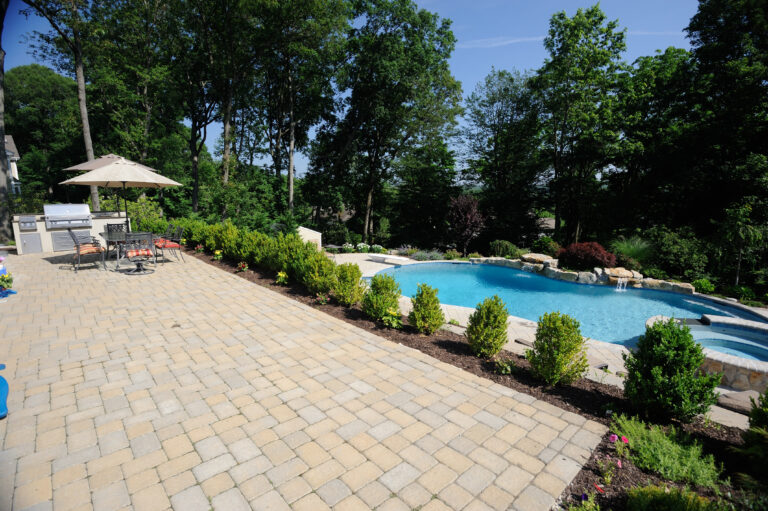
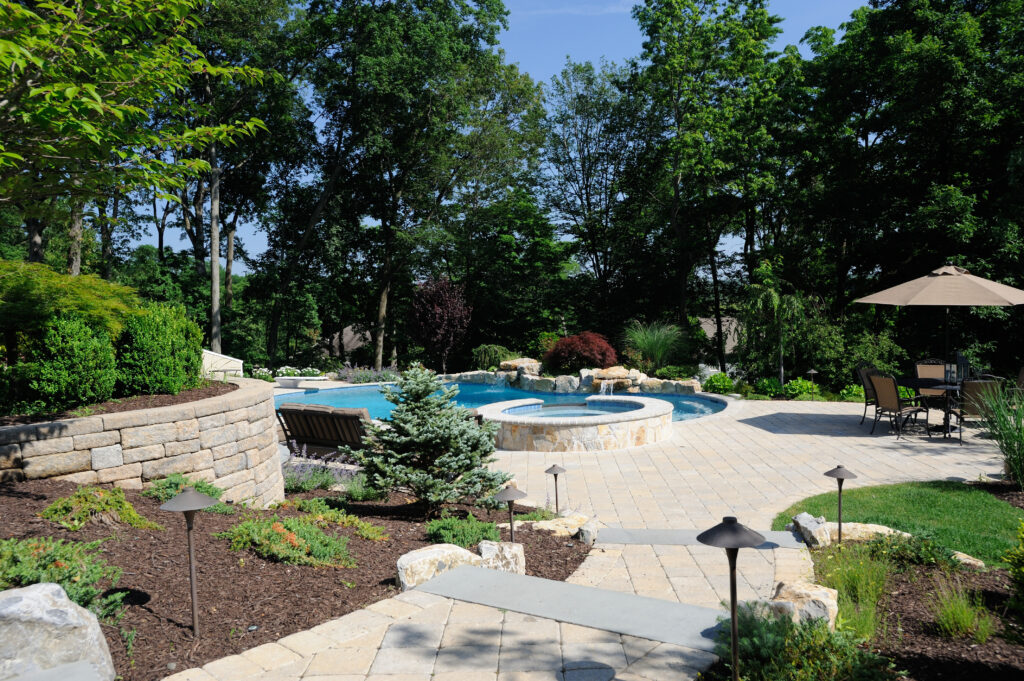
Renovating your pool provides an opportunity that most homeowners don’t think about until they’re already in the middle of the project: the ability to create a comprehensive outdoor living space. Placing an outdoor kitchen next to the pool deck — complete with a built-in grill, prep counter, mini fridge, and bar seating — turns your backyard from a place where people swim into a place where people actually spend their evenings. Pergolas and shade structures give the space architectural interest, create a sense of enclosure that makes the area feel purposeful, and provide practical shade from the direct sun during the afternoon hours when the pool is used the most.
For these additions to work together, they should be considered as part of the same design conversation as the pool, not as separate projects added later. When the pergola posts match the coping tone, when the outdoor kitchen countertop echoes the decking material, and when the lighting flows seamlessly from the pool to the entertaining zone, it feels like a fully realized outdoor room, not a collection of separate improvements. This level of integration is what separates a good renovation from a great one.
Choosing the Right Pool Renovation Contractor in NJ
The contractor you select will be the deciding factor in whether your renovation is successful or whether it turns into a costly, long-drawn-out nightmare. There are plenty of pool contractors in New Jersey, but the difference between the best and the rest is huge. The knowledge of materials, local permitting experience, design capability, and post-installation support can vary greatly from one company to the next. These differences will be reflected in the final product and its durability.
One crucial thing to remember is that cost should never be the sole determining factor. The cheapest quote for a pool renovation will almost always mean that corners have been cut somewhere – whether it’s in the quality of the materials, the experience of the team, the preparation of the site, or the warranty. Obtain three detailed, itemized quotes and compare them. If one quote is significantly cheaper than the others, ask why. The response will give you all the information you need.
What to Look for in a Pool Contractor: Licenses, Insurance, and Local Experience
When looking for a pool contractor in New Jersey, ensure that they hold a valid NJ Home Improvement Contractor (HIC) registration and have both general liability insurance and workers’ compensation coverage. Don’t just take their word for it, ask for certificates of insurance directly and make sure that the coverage limits are adequate for the scope of work. If the renovations include structural work, electrical upgrades, or gas line modifications, make sure that the contractor pulls the required permits with your municipality. If a contractor suggests skipping permits to save time or money, they’re creating a problem that will come up when you sell the home or file an insurance claim.
Apart from qualifications, nothing beats local experience. If a contractor has been operating specifically in Central and North-Central New Jersey, they’ll have a good understanding of the local soil conditions, drainage requirements, municipal permit expectations, and — crucially — what materials and installation techniques can withstand NJ winters. That’s the kind of knowledge you can’t get from a contractor who mostly works in warmer climates or doesn’t have much local experience.
What to Ask Before You Sign on the Dotted Line
Don’t sign a contract with a renovation contractor before you’ve asked these questions and received clear answers, preferably in writing:
- How many pool renovations have you completed in this specific area of New Jersey, and can you provide local references?
- Who will be on-site managing the project daily, and what is their experience level?
- What is the exact resurfacing material being specified, and what is the manufacturer’s warranty on that product?
- Will you pull all required permits, and is permit cost included in the quoted price?
- What does your warranty cover, and for how long — specifically for the finish, the equipment, and the workmanship?
- What is the payment schedule, and what are the milestones tied to each payment?
- How do you handle unexpected discoveries mid-project, such as structural issues found during demolition?
A contractor who answers these questions confidently and without hesitation is demonstrating the kind of professionalism and accountability that leads to a successful project. Vague or defensive answers to straightforward questions are a red flag worth taking seriously. For more insights, you might find this Reddit discussion helpful.
Renovating Your NJ Pool Will Always Give You More Bang for Your Buck
Renovating an existing inground pool will always give you more bang for your buck, especially when the structural shell is still in good shape. This is one of the best investments a New Jersey homeowner can make in their backyard. You get a completely transformed space with new surfaces, upgraded equipment, and updated design, but at a fraction of the cost of building a new pool. Plus, you won’t have to deal with all the permit waiting times and site disruption that comes with building a new pool. If you choose high-quality materials that are suitable for NJ’s climate and work with a contractor who treats the pool and the surrounding landscape as one unified project, your renovation will not only restore your pool but make it significantly better.
Commonly Asked Questions
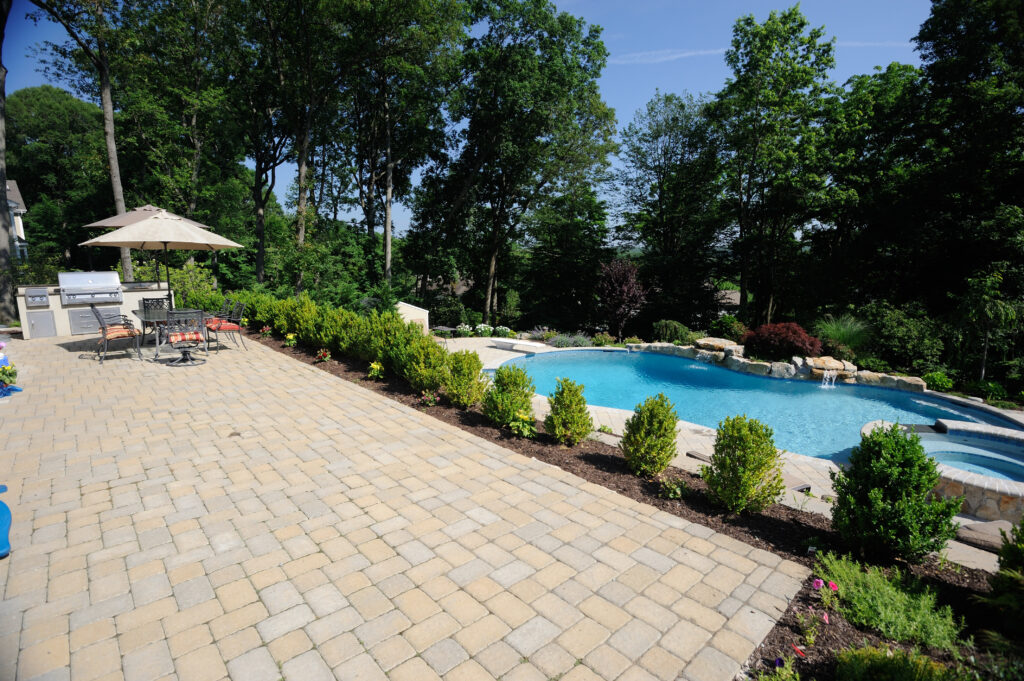
When you’re thinking about renovating your inground pool in New Jersey, you probably have a few practical questions that go beyond just design ideas. The answers below address the most frequent issues that NJ homeowners bring up when they’re trying to make the decision to renovate — costs, timelines, how well materials perform, and return on investment.
Keep in mind, each pool and backyard is unique, so the figures and timelines provided below should be seen as a ballpark range rather than hard and fast rules. To get the most accurate estimate for your specific pool, property, and project goals, you’ll need a detailed site assessment from an experienced local contractor.
Use these responses as a foundation — a way to approach contractor discussions with prior knowledge, so you can ask more insightful questions and assess the responses you receive with greater certainty.
What is the cost of renovating an inground pool in New Jersey?
In New Jersey, a basic renovation that only includes resurfacing typically costs between $10,000 and $20,000. The cost depends on the size of the pool and the type of finish material used. A more comprehensive renovation, which includes resurfacing, new tile and coping, deck replacement, and equipment upgrades, generally costs between $25,000 and $55,000. A full transformation, which includes water features, spa additions, outdoor kitchen integration, and a complete landscape redesign, can cost more than $80,000 to $100,000. These prices reflect the cost of quality materials and the prices in the New Jersey market. Bids that are significantly lower usually indicate that the scope or quality of the materials will be compromised, which will cost more to fix in the future.
How much time does it take to renovate a pool in NJ?
For a basic resurfacing job with tile and coping replacement, you’re typically looking at a timeline of two to three weeks. If you’re opting for a full renovation that includes surfaces, equipment, and decking, that timeline extends to four to six weeks. Larger projects that involve structural changes, water feature additions, or complete backyard redesigns can take anywhere from eight to twelve weeks or longer. Keep in mind that the time it takes to get permits can vary. Some NJ municipalities are quick to issue permits, while others can add several weeks to the start of a project. If you plan and contract in the fall or winter, you’ll have a much better chance of getting the schedule you want and a more predictable timeline.
Is it possible to renovate my pool and update the surrounding patio at the same time?
Absolutely — and it’s almost always a smarter move to do both at the same time. Having the same contractor manage pool resurfacing and deck replacement at the same time can help you avoid paying twice for mobilization costs. It also ensures that the grading and drainage are handled as a single system. The end result is a pool and surrounding hardscape that are visually and functionally designed to work together. Trying to match new decking materials to an existing pool finish after the fact, or retrofitting drainage around a completed deck, often leads to subpar results compared to planning both from the start.
Which pool surface material is the most durable in New Jersey’s weather?
In the freeze-thaw conditions of New Jersey, pebble aggregate finishes regularly outlast other resurfacing materials. Brands such as Pebble Tec and Pebble Fina use natural river pebbles that are tougher and less likely to react with chemicals than plaster, resulting in a significantly longer lifespan — usually 20 to 25 years or more with proper water chemistry maintenance. Quartz aggregate finishes like SGM’s Jewels of the Sea line are a durable mid-range choice with a typical lifespan of 12 to 15 years. White plaster, while the cheapest choice, is the most susceptible to NJ’s weather conditions and usually needs resurfacing every seven to ten years.
Surface Material Typical Lifespan in NJ Freeze-Thaw Resistance Maintenance Demand Relative Cost White Plaster 7–10 years Low High $ Quartz Aggregate (e.g., SGM Jewels of the Sea) 12–15 years Moderate–High Moderate $$ Glass Bead Finish 15–20 years High Low–Moderate $$$ Pebble Aggregate (e.g., Pebble Tec) 20–25+ years Very High Low $$$
The higher upfront cost of a pebble finish versus white plaster looks different when you calculate cost per year of service life. A white plaster job at $12,000 that needs redoing in eight years costs $1,500 per year. A Pebble Tec finish at $22,000 that lasts 22 years costs $1,000 per year — and looks dramatically better throughout its entire lifespan. In New Jersey’s demanding climate, investing in a more durable finish is almost always the financially rational choice when viewed over a ten-year horizon.
Keeping your water chemistry in check is crucial to the lifespan of any finish, no matter what material it’s made of. If you keep your pH, calcium hardness, and alkalinity levels in the correct range, you can avoid chemical etching and staining that can make your pool surfaces look old before their time. You might want to think about getting an automated chemical dosing system, which are now available for all budgets, as part of any renovation. They can help keep your water balanced and can contribute to the long-term performance of your finish.
Will renovating my pool increase the value of my home in NJ?
Having a well-kept, beautifully renovated inground pool can definitely increase the appeal and marketability of your New Jersey home, especially in suburban areas where outdoor living space is a key factor in attracting buyers. While the exact return on investment can vary depending on the neighborhood, the price point of your home, and the extent of the renovation, a pool that looks clean, up-to-date, and well-integrated into the landscape can be a real asset in NJ’s competitive real estate market. On the other hand, a pool that has been neglected or that looks outdated can actually turn off potential buyers, who may see it as a liability and a potential future expense.
The main difference is that the condition of the pool and its surroundings are just as important as the pool itself. A newly resurfaced pool with updated coping, new decking, and a cohesive landscape design sends a message of care and quality throughout the property. This perception leads to stronger offers and faster sales in markets where outdoor living is valued — which is most of Central and North-Central New Jersey. The renovation essentially turns a deferred maintenance liability into a real selling asset.